In addition to writing a blog as a hobby, I also write songs. The first song I wrote was at 19, for a girlfriend. However, it wasn’t until 2017 that I began writing songs more seriously. I must have churned out almost 10.
One tune I wrote in 2017 was called “You Gotta Say Grace.” It’s a song that reminds the listener to be thankful for the small but amazing things that occur in daily life and to try not and overlook or disregard them.
The first line of the song: “Sometimes/In our lives/We fail to appreciate.”
And it’s true. I mean, how often do we stop to appreciate that our bodies are working properly or to enjoy the feeling of warm sunlight on our skin? It’s super easy to get lost in routine and in the discomforts of having to perform certain routines.
For example, this morning I went for a walk with my dog at the dog park. It was around 6 a.m. and all I could do really, or least initially, was focus on how tired I was and how biting the wind was. But after some time at the park, sitting at a bench and playing fetch with the pup, I realized that I was “failing to appreciate.”
So I had an idea. Because I’ve been into birds lately -- have a look at one of my recent blog posts -- I thought I would write about all the birds I saw during my walk to and from the dog park and where I saw them. Such an exercise, I thought, could be fun and would help me renew the promise I made to myself when I wrote “You Gotta Say Grace.”
OK, so. . . after I left my apartment, the first bird I saw -- one that I see everywhere in Hamburg -- was a Eurasian Blackbird. It was walking on a large lawn adjacent to an apartment building, foraging for food. Eurasian blackbirds, the males at least, are small, have black plumage and short yellow beaks. Thanks to a memory game I recently got on birds, I knew that the blackbird that I was looking at on the lawn -- based on its appearance, brown plumage instead of black -- was a female. Pretty cool.
At the park -- a really pretty park I should add, one that is right on the Alster -- my dog lunged at something that had been on a railing that I was leaning against. I had been looking down at my iPod before my dog jumped forward, but when she did, I looked up to see a crow flying away.
After the park, I decided to walk down a street that I don’t usually walk on because I wanted to get rolls from a bakery. At one point, I paused before a sign in front of a house that was actually a veterinary clinic. As I stood there reading the opening hours -- it’s always good to know the opening hours of a nearby vet when you have a dog -- a small little bird flew onto the waist-high metal fence in front of me.
I had seen this bird before, but it wasn't one I see often. It was very small -- maybe a little bigger than a sparrow, but rounder, one might even say bulbous, almost like the shape of a Hostess “Snoball” -- and was mostly tan, though its plumage was a blood orange red around the chest and face. It was a European Robin.
Still on the same street, while looking up at one of the many nice, 3-story apartment buildings facing it, I saw two Magpies, one of which was hopping along on a balcony.
Once I got to the main street, I saw one of my favorite birds: the Eurasian coot. I like the Eurasian Coot for two reasons. One, though it’s black, its distinctive white bill and the nub above it, located between its eyes, are white, which makes the creature look like it’s wearing a Phantom of the Opera mask. I get such a kick out of this feature and the bird's overall appearance. Two, this bird is out in all weather -- even in the coldest days of winter. When the swans are all gone and the ducks aren’t anywhere to be found, you can still find the Eurasian Coot out, dutifully motoring around. Because the bird is so rugged and so often "on the scene" I've come to think of it as a real hard worker -- a "grinder," and I this is an attribute I can relate to, though of course I'm anthropomorphizing.
After the bakery, I headed home, and on the street leading to my apartment, I saw a pigeon fly up onto the roof of a two-story house. However, this pigeon wasn’t your average pigeon. No, it was a wood pigeon. Wood pigeons are like common pigeons that have received an upgrade. If the common pigeon -- also known as the rock pigeon -- were to be dusted off and began doing yoga -- it would look more like the wood pigeon.
So there you have it, a normal walk transformed. The walk could have been just a routine thing. But what fun would there have been in that? “Sometimes/In our lives/We fail to appreciate.” I think this time at least I succeeded instead.

Sunday, June 24, 2018

Tuesday, June 05, 2018
Rivers
“Stadt, Land, Fluss” -- or "City, Country, River," -- is the name of a popular game here in Germany. To play it, you take a piece of paper and at the top write five or six categories. The categories are divided from each other by vertical lines. The first three categories must always be “City,” “Country” and “River” -- hence the name of the game. The other categories can be decided upon, but players usually go with, “Animals,” “Colors,” “Famous People” and "Professions."
After you have written out the categories, one player says the first letter of the alphabet out loud and then continues on saying the rest of the alphabet to himself. Another player then says, “stop” at the moment of his choosing and when he does, the player who had been saying the alphabet to himself tells the players which letter he was up to.
So, for example, if the player who had been saying the alphabet to himself says he was up to the letter “S” when his opponent said "stop," all the players would then have to fill in each of their categories columns with a noun that starts with "S." For each entry you get correct, you get points.
Pretty simple game, huh?
Yeah, except there’s just one catch. The rivers. The rivers always snag people. People can think of a few rivers, but really not that many. Knowledge of rivers is gold in this game.
So why am I writing all of this? Well, I have a student who loves to play “Stadt, Land, Fluss” with me. Every time we play it, it’s like she’s playing the game for the first time; it’s all brand new, and I love that, find it very encouraging. The problem is, though, both she and I always get snagged at the rivers. It's hard to name rivers!
Well, last time before we started to play, a light bulb went off. I said to her, "Why don’t we memorize a river for every letter of the alphabet? Well, we did that and the list we came up with is below. I hope to learn all 26 rivers and then be a champ at this game. I mean, the "Zam River"? Who's going to know a river starting with the letter "Z," let alone the Zam River (which is in Romania, by the way)?
The Amazon
The Biber
The Colorado
The Don
The Elbe
The Fish River, Alaska
The Ganges
The Harlem River
The Inn
The Jade River, Germany
The Kuban River, Russia
The Lena River, Russia
The Mississippi
The Nile
The Ob, Russia
The Peace River, British Columbia
The Queen River, Rhode Island
The Rhein River
The Seine
The Tigris
The Ural River, Russia
The Volga
The Weser, Germany
The Xin River, China
The Yellow River, China
The Zam River, Romania
After you have written out the categories, one player says the first letter of the alphabet out loud and then continues on saying the rest of the alphabet to himself. Another player then says, “stop” at the moment of his choosing and when he does, the player who had been saying the alphabet to himself tells the players which letter he was up to.
So, for example, if the player who had been saying the alphabet to himself says he was up to the letter “S” when his opponent said "stop," all the players would then have to fill in each of their categories columns with a noun that starts with "S." For each entry you get correct, you get points.
Pretty simple game, huh?
Yeah, except there’s just one catch. The rivers. The rivers always snag people. People can think of a few rivers, but really not that many. Knowledge of rivers is gold in this game.
So why am I writing all of this? Well, I have a student who loves to play “Stadt, Land, Fluss” with me. Every time we play it, it’s like she’s playing the game for the first time; it’s all brand new, and I love that, find it very encouraging. The problem is, though, both she and I always get snagged at the rivers. It's hard to name rivers!
Well, last time before we started to play, a light bulb went off. I said to her, "Why don’t we memorize a river for every letter of the alphabet? Well, we did that and the list we came up with is below. I hope to learn all 26 rivers and then be a champ at this game. I mean, the "Zam River"? Who's going to know a river starting with the letter "Z," let alone the Zam River (which is in Romania, by the way)?
The Amazon
The Biber
The Colorado
The Don
The Elbe
The Fish River, Alaska
The Ganges
The Harlem River
The Inn
The Jade River, Germany
The Kuban River, Russia
The Lena River, Russia
The Mississippi
The Nile
The Ob, Russia
The Peace River, British Columbia
The Queen River, Rhode Island
The Rhein River
The Seine
The Tigris
The Ural River, Russia
The Volga
The Weser, Germany
The Xin River, China
The Yellow River, China
The Zam River, Romania
Sunday, June 03, 2018
Birds

I once told a friend of mine that I was able to imagine myself becoming interested in birds when I got older. My friend and I would often laugh at this thought, picturing me as a gray-haired man with binoculars around his neck, on the lookout for beautiful winged creatures.
To this friend’s and my surprise, I’ve actually gotten into birds a lot sooner. The interest was spurred by having had the opportunity to observe the swan, geese and other waterfowl in the waterways near my home. Especially exciting was having had the opportunity this spring to observe a bird called a
Eurasian coot (pictured above) build her nest, roost on her eggs and then tenderly care for her chicks after they were born.
Below you will find an email I recently wrote to my mom about my new interest in birds, along with her response. My mother had always liked birds, but I never really paid attention when she would tell me about the ones that she had seen on her travels. I only paid half attention to her, like when she would tell me about the different types of flowers she had bought for her balcony. But now, of course, I’m paying attention.
I hope you see, as I do, the bit of poetry in this email exchange. Enjoy.
***
Hi Ma,
I forgot to tell you but recently I've gotten into birds. For my birthday I even got a bird memory card game and I was so excited when I learned my first bird. Remember when I told you this one bird looked like the Phantom of the Opera, with a white mask? Well this bird is actually called the Eurasian coot. You should look it up. I also now can identify a Eurasian sparrow, both male and female, and a Mallard duck and a mute swan.
Hi,
I think getting into birds is really cool. They're great. I checked out all the birds you mentioned and the Eurasian coot really is the "phantom" of birds.
When I go to Wakodahatchee Wetlands, I see wood stork, multiple varieties of herons, great white egrets, anhingas and other great birds. Sometimes there are so many great blue herons in the trees, they look like ornaments. That's why I drive 70 miles round trip two to three times a week. I've watched the storks build their nests this year, with two of them fighting over branches. I saw the eggs and then the sweet little babies.
Send me the names of any other bird that you identify. I'll definitely check it out.
Love,
Mom
Tuesday, May 22, 2018
A rip-off
 Well, that was quite the wake-up call.
Usually, I don’t look at the price when I’m buying produce. I mean, I have an idea what the items cost, but I just sort of let the cashier ring up the stuff and I'm content to pay.
Today, all the money I had on me was one euro. With it, I figured I would buy two apples at the supermarket before going home. I have been eating a lot of yoghurt with fruit lately, so I thought two apples would be perfect -- I’d have a bowl of yoghurt with fruit now and another later.
When I got to the cash register, the woman rang me up. "1.45 euros." I couldn’t believe it. “What!" I exclaimed.
“Oh, are they Elstars?" the lady said, referring to the type of apples they were. "Those are expensive."
But it really didn’t matter what kind of apples they were. 1.45 for two apples is a rip-off. I mean, just down the road at another supermarket, you can get a bag of 20 apples for about 2.50 euros, which means that the apples at this second supermarket are six times cheaper.
I just paid for one apple and left.
A wake-up call indeed.
Friday, May 18, 2018
Between Them

One thing I've noticed is I do a lot of explaining on this blog. Whenever I post something, I want to be crystal clear. This makes sense because as a writer, I have always prided myself on my clarity. I like to break things down for the reader.
But, I must say, doing so usually involves a lot of explaining. Sometimes I even over-explain, so much so that people who have edited my stuff have said to me, “Chad...we get it.” Well, for this next post, I thought I would do the opposite -- I would refrain from explaining.
Recently, I finished the book “Between Them,” a memoire that the author Richard Ford wrote about his parents. As I read the book, I underlined the sentences and passages I especially liked. I do this with all my books.
In the following post, I’m going to reproduce each and every line or passage I underlined in "Between Them." But I’m not going to provide context -- no explaining, no set up, just the things I underlined. I thought this could be a fun exercise, as it will force you -- and me, probably -- to draw different kinds of conclusions.
So, without further ado, here goes.
***
“Whereas being ignorant or only able to speculate about another’s life frees that life to be more what it truly was.”
“…being together in a way that defines category. They more than certainly had that in them.”
“He was her protector, be she was his.”
“Possibly he dreamed at night … of winding curb-less streets without transients for neighbours.”
“Between them…”
“He was invisible, but different from how he’d been invisible. It satisfied him almost completely.”
“In retrospect, the advent of death can cast a too dramatic light on the events leading toward it.”
“There is one quality of our lives with our parents that is often overlooked, and so devalued. Our parents intimately link us, closeted as we are in our lives, to a thing we’re not, forging a joined separatness and a useful mystery, so that even together with them we are also alone.”
“‘Oh, yes. Your mother’s the cute little black-haired woman up the street.’ These were words that immediately affected me, and strongly, since they proposed my first conception of my mother as someone else, as someone whom other people saw and considered and not just as my mother.”
“It is, of course, a good lesson to learn early—cute, little, black-haired, five-five—since one of the premier challenges for us all is to know our parents fully—assuming they survive long enough, are worth knowing, and it is physically possible. The more we see our parents fully, after all, see them as the world does, the better our chances to see the world as it is.”
“A life lived efficiently wouldn’t save you, but it would prepare you for what you couldn’t be saved from.”
“His job may have even have been harder than ours was—though only on that day.”
“The obvious question—how serious is all this?—can be dispensed with in a hurry: the very worst.”
“And still, in a way, even this news did not change things. The persuasive power of normal life is extravagant. To accept less than life when less is not overwhelmingly upon you is—at least for some—unacceptable.”
“I resumed my teaching and talked to her most days, though the thought that she was getting worse, that bad things were going on, and I couldn’t stop them, made me occasionally miss calling. It quickly became an awful time for me, when life felt to be edging toward disastrous.”
“And that was how we did that. One more kind of regular life between us. I went to campus, did my work, came home nights. She stayed in the big house with my dog. Read books, magazines. Fixed lunches for herself. Watched the Dodgers (this time) beat the Yankees in the Series. Watched Sadat be assassinated. Looked out the window. At night we talked—never serious or worrying things. With Kristina, who was working in New York and commuted on weekends, we went on country drives, looked at antiques, invited visitors, lived together as we had in places far and wide all the years. I didn’t know what else we were supposed to do, how else such a time was meant to pass.”
“My mother’s eyes were very brown.”
“I never saw her dead. I didn’t want to. I simply took the hospital’s word when the nurse called early one December morning, just before her birthday.”
“But, as I said, I saw her face death over and over through that autumn. And because I did, I believe now that witnessing death faced with dignity and courage does not confer either of those—only pity and helplessness and fear. All the rest is just private—moments and messages the world would not be better off to know.”
“My mother and I look alike. Full, high forehead. Same chin, same nose. There are pictures to show it. In myself I see her, hear her laugh in mine. In her life there was no particular brilliance, no celebrity. No heroics. No one, crowning achievement to swell the heart. There were bad things enough: a childhood that did not bear strict remembering; a husband she loved forever and lost; a life to follow that did not require much comment. But somehow she made possible for me my truest affections, as an act of great literature bestows upon its devoted reader. And I have known that moment with her we would all like to know, the moment of saying, Yes. This is what it is. An act of knowing that confirms life’s finality and truest worth. I have known that. I have known any number of such moments with her, known them at the instant they occurred, and at this moment as well. I will, I assume, know them forever.”
Saturday, April 21, 2018
The Deliveryman

Recently, I have been researching a story about the 75th anniversary of the Bombing of Hamburg during World War II. For my research, I have been meeting with people who survived the event. Actually, these are people who have not only survived the event but have also made themselves available to talk about it and any other event in history. In Germany such people are called "Zeitzeugen," or contemporary witnesses. Zeitzeugen usually travel to schools and tell students how things were -- the good, the bad and the very bad.
Yesterday, I had a meeting with a Zeitzeuge, a woman who was about 9 years old when WWII broke out. We spent a few hours together at her home and she told me interesting things about the Bombing of Hamburg. However, I was more interested in some of the other stories she had to tell. Some of her best stories she had already typed out and had made copies of. Below is one the stories that she had already made a copy of. It doesn't a happy ending, but I do think it is compelling. The story was given to me on a sheet of paper in German. I'm going to translate it, of course, but I'm going to preserve her spacing. I hope you appreciate it.
***
"The Nice Mr. Wolpert"
My mother used to operate a tobacco and jam shop in Wilhemsburg, Hamburg. The small shop was attached to our house and it was my mom’s principal place of employment until a bomb destroyed our house.
I have a vivid memory from 1941 or '42, when I was around 11 years old, that is connected to this shop.
Mr. Wolpert, a nice man, was one of the men who delivered cigarettes to the store. My mother enjoyed his presence every time he came by. Sometimes I would be in the store during his visits and Mr. Wolpert and I would greet each other.
After he had finished discussing businesses with my mom, he would talk with me. He would ask about school and he would ask me which of my subjects was my favorite and whether or not I got to school by bike or by foot. Often he told us of his family and he asked whether I had nice friends and which books I liked to read. Every time after he would leave, he would nicely say, “See you next time.”
One day we were sitting eating lunch when all of a sudden my mom walked in, really upset. She had just come from the store and she said: “You’re not going to believe it, but Mr. Wolpert just stopped by to say goodbye. On his jacket he was wearing his Jewish star and he looked very pale. He said that was going to get picked up soon.” “Where is he going?” I asked, to which my mother replied, “He will be brought to a labor camp [“Arbeitslager”] and he won't be coming back again.” My mother and my grandmother looked very downcast.
“Who exactly are these people, these Jews?" I thought to myself. My mom never told me anything about them. On the afternoons I would go to the Hitler Youth, we were told that Jews were a dishonest and conniving people and were mostly money lenders and fraudsters. But that absolutely does not describe our Mr. Wolpert! Never!!
I cannot fathom it, I'm stunned.
We never saw him again.
Thursday, April 19, 2018
That Was Difficult
This week I have been asking the students in my English classes to write a small essay about a difficult decision that they’ve made in their lives. After the students submit their essays, I mark them and then give each student feedback on his or her writing. The whole process is relatively easy for me. However, I haven’t once stopped to think about how the exercise is for the students. Is it very difficult to write an essay in another language? To be fair, I decided to write the essay that I have been assigning, in German. What’s it like to write a small piece in another language? Let’s find out.
Als ich meinen Bachelor-Abschluss in 2006 kriegte, kriegte ich danach sehr schnell einen Job. Die Stelle war eine Werbetexten Stelle für eine Firma. Jedoch entdeckte ich an meinem ersten Tag, dass die Chefin der Firma wolltet, dass ich „sales calls“ mache. Ich sagte ja, weil ich einen guten Eindruck machen wollte. Jedoch sagte ich auch, dass ich irgendwann schreiben wollte. Meine „kleine Chefin“ versprach mir, dass ich irgendwann schreiben würde.
Der ganze Sommer vergang, und ich schriebe gar nichts. Jeden Tag machte ich die blöden „cold calls“. Ich verdiente sehr gut aber ich war sehr unglücklich.
Also musste ich eine Entscheidung treffen. Soll ich in dem gutbezahlten Job bleiben oder soll ich den Job kundigen und dann nach einem anderen Job suchen.Ich kündigte. Es war schwierig, eine Entscheidung zu treffen, weil zurzeit ich nicht wusste, was passieren würde, wenn ich den Job kundigen würde. Jedoch war ich nicht glücklich mit diesem Job.
Vier Monate später kriegte ich einen neuen, besseren Job und ich war sehr glücklich damit. Ich denke, ich traf die richtige Entscheidung.
Phew. That was really hard. No joke. I thought it was going to be a little bit easier. But wow. It took me a good hour to get that as perfect as I could. I guess I should not be so cavalier next time I tell my students to just fire off an essay on the topic of my choice.
„Eine Schwierige Entscheidung“
Als ich meinen Bachelor-Abschluss in 2006 kriegte, kriegte ich danach sehr schnell einen Job. Die Stelle war eine Werbetexten Stelle für eine Firma. Jedoch entdeckte ich an meinem ersten Tag, dass die Chefin der Firma wolltet, dass ich „sales calls“ mache. Ich sagte ja, weil ich einen guten Eindruck machen wollte. Jedoch sagte ich auch, dass ich irgendwann schreiben wollte. Meine „kleine Chefin“ versprach mir, dass ich irgendwann schreiben würde.
Der ganze Sommer vergang, und ich schriebe gar nichts. Jeden Tag machte ich die blöden „cold calls“. Ich verdiente sehr gut aber ich war sehr unglücklich.
Also musste ich eine Entscheidung treffen. Soll ich in dem gutbezahlten Job bleiben oder soll ich den Job kundigen und dann nach einem anderen Job suchen.Ich kündigte. Es war schwierig, eine Entscheidung zu treffen, weil zurzeit ich nicht wusste, was passieren würde, wenn ich den Job kundigen würde. Jedoch war ich nicht glücklich mit diesem Job.
Vier Monate später kriegte ich einen neuen, besseren Job und ich war sehr glücklich damit. Ich denke, ich traf die richtige Entscheidung.
Phew. That was really hard. No joke. I thought it was going to be a little bit easier. But wow. It took me a good hour to get that as perfect as I could. I guess I should not be so cavalier next time I tell my students to just fire off an essay on the topic of my choice.
Saturday, April 07, 2018
Invisible Transitions

I once read in a book about writing that the best transitions were none at all. What the author of the book meant was that a properly used transition word, such as “however” or “therefore,” can be effective, but the best transitions between paragraphs, or even sentences, involve no transition words whatsoever.
Today, as I was listening to the Gettysburg Address -- don’t bother asking why I was listening to the Gettysburg Address; I just was -- I noticed that it was a good example of a piece of writing that moves seamlessly from one thought to another without the use of transition words.
To show you exactly what I mean, I'm going to reproduce the super famous speech, or at least the part of it that relates most to my point, and I’m going to highlight the words that Lincoln uses to connect his ideas in subsequent pieces of text with those in previous ones.
I hope you find it all of some interest.
Four score and seven years ago our fathers brought forth on this continent, a new nation, conceived in Liberty, and dedicated to the proposition that all men are created equal.
Now we are engaged in a great civil war, testing whether that nation, or any nation so conceived and so dedicated, can long endure. We are met on a great battle-field of that war. We have come to dedicate a portion of that field, as a final resting place for those who here gave their lives that that nation might live. It is altogether fitting and proper that we should do this.
Saturday, March 17, 2018
Just Right
OK, so I was just teaching an English class, and to fill some spare time at the end of the lesson, I told the students a small story from my life. I had known that the story was amusing, but the students thought it was exceptionally funny. I'm going to reproduce this story below.
A tiny bit of backstory before we get started: the tale is about my experience buying a mattress. That’s about all you have to know. Oh, also, I’m going to write the story in a manner similar to how I related it orally, just for fun. Enjoy.
Oh, man, do I have a funny story for you when it comes to buying a mattress. OK, so a few weeks ago I bought a new mattress. I had really liked this one particular mattress in the store, but when the thing arrived at my house, I was unhappy with it because it was too hard. When I called the store to ask if I could return it, they said no. When I asked them why the mattress I had tried at the store was soft and the one I had in front of me was so hard, they said, "Well, the mattress in the store has been lain on thousands of times." Great, I thought, just great! I was really upset. My girlfriend, however, said that I should not worry. She said once the mattress was broken in, everything would be fine.
A few weeks, later the mattress was still totally hard. But things weren't all lost because my girlfriend, who lives with me, still had her own mattress, from her old apartment. But that particular mattress had been too soft. What were we going to do? We did some thinking and came up with an idea: What would happen if one lay a soft mattress on top of a hard one? And would you know, the answers is this: You get the perfect mattress! Yup, the mattress on which we now sleep -- it's actually two mattresses -- isn’t too hard or too soft. It's just right.
How great is that? Oh, oh, also, this story has a funny coda. After this was all said and done -- it was probably about two weeks later -- my girlfriend and I went back to her hometown for a weekend. When we were there, we stayed at her mom’s house and slept in her childhood bed, like you do. And this bed, wow, let me tell you, it was a stone. It was the hardest bed I had ever slept in. When the weekend was over, I asked my girlfriend what was up with that bed. She then said to me, "Oh, it's always been like that. I've had it for 15 years."
I couldn’t believe it. "15 years!” I said, “and it’s always been like that!” I was flabbergasted. “OK, so then what made you think that the mattress that I had bought was going to get any softer?” And at that, she just smiled. She smiled because she had been gotten. She had no answer.
Saturday, January 13, 2018
Arm & Hammer
A former U.S. poet laureate once said that one quality that
makes a great poem is specificity. As an example, he cited a poem about the culling of chickens and
how the event was meticulously, even lavishly, described.
I really agree with his statement. If you look at great
poems, one common denominator that they often have is that the objects and
images described within them have been described accurately and with great specificity.
For example, just think about how well Wordsworth describes
the abundance of daffodils in his poem “I Wandered Lonely as a Cloud”:
Continuous as the stars that
shine
And twinkle on the milky way
They stretch in never ending line
Along the margin of a bay
Or how about how ominously Edgar Allen Poe depicts the
raven:
And
his eyes have all the seeming of a
demon’s
that is dreaming,
And
the lamp-light o’er him streaming
throws
his shadow on the floor
There is certainly something about specificity that makes it
an undisputed ingredient of good writing.
Enter Kevin Gates, a rapper from Baton Rouge, Louisiana.
Kevin Gates is a badass, tattooed-covered dude who wears diamond studded fronts
– or, a “mouth full of ice” – in many of his music videos. He had been or still
is very involved in street life and has served time in prison on several
occasions.
At first blush, he’s not the kind of guy one would think would have something in
common with Wordsworth or Edgar Allen Poe.
But he does. It’s the writing. Yes, Gates lives in a totally
different era from the other two writers and has quite the different lifestyle,
but he too has written something that transcends the mundane, or even the good,
thanks to specificity.
On his 2014 mixtape “By Any Means,” Gates has a song called
“Arm and Hammer.” Yes, that’s the Arm & Hammer that your mom used to put in
the refrigerator to absorb odors. However, drug dealers also use Arm & Hammer, which is really sodium bicarbonate, to turn cocaine into crack. Gates’
song of course refers to the latter usage. The main idea of the song is that
the narrator is so successful as a drug dealer that he keeps running out of Arm
& Hammer.
Now, of course I don’t condone drug dealing and drug use. But by zeroing in on this one object, Arm & Hammer, and its importance in the world of a drug dealer, Gates has written
something that surpasses good and rises to the level of exceptional. By
focusing on this one object – an object one would never think to write a song
about or to make art about -- he really brings us vividly into his world.
Monday, December 25, 2017
Refugee story from 2015
During the summer of 2015, about a million refugees from war-torn Syria and the surrounding area came
pouring into Germany. For
journalists, especially in Germany, this was a big deal. I mean, tectonic plates were
shifting and the influx of people created thousands of story opportunities. How, for example, were the refugees fitting in? Where were they being housed? What problems were they facing? How had the journey been? The opportunities for stories were endless.
Now enter me. The only real thought I had to myself during this
time, journalism-wise, was, "Dude, if you don't write at least a few
stories off this, there is something wrong with you." Well, in the end I did write a few stories related to the refugee situation, but I'm most proud of the one below.
A bit of backstory: around Christmas 2015, I would always pass this
one particular area at the main railway station in Hamburg. It was this makeshift
command post for refugees who were just arriving or stuck in limbo or just needed some
help. What struck me about this command post was how ragtag, yet efficient it seemed. They had translators at the place, supplies, bulletin boards, and there would always be people manning the area, even around the clock.
I became intrigued about the people working at this station. Below is a story I wrote about them. I had sent the piece on spec to the Christian
Science Monitor. Unfortunately, the editor there said, "We are pretty well covered on
the subject," and passed. All right. But here the story is. I
thought it was worth sharing, even if two years have elapsed.
***
For the last five months, a small brigade of volunteers
working at a makeshift aid station at the Hamburg Central Train Station has
been offering various forms of assistance to the droves of Syrian, Iraqi and
Afghani refugees who have been passing through Hamburg on their way to
Scandinavia to seek asylum.
The volunteers, most of whom are German citizens but some of
them refugees themselves, translate for the newly arrived refugees, help them
buy the proper train tickets and show them where they can get food and water.
They also help the refugees solve the many unique problems that they face.
It has been well documented how kind and generous many
Germans have been to the refugees who have been arriving in Germany from
war-torn countries. But the aid station is a good representation of how
grassroots and vigorous the effort to help the refugees often is.
“We just try to help the refugees however we can; the most
important thing is that help is being given,” said Felix Brugger, 27, a
volunteer at the aid station, which is located in the train station’s main
entrance hall. Brugger made his comments after having just told two Afghani
refugees which route they need to take to reach a particular city in Sweden.
Ever since last September, when Angela Merkel began allowing
thousands of refugees to enter Germany, a couple hundred refugees have been
arriving at the Hamburg Central Station each day.
Though the German government gives cash subsidies and other
benefits to refugees who are in the process of seeking asylum in Germany, the
refugees at the Hamburg train station are looking to go to Scandinavia, which
means that the German government views them as “Transitflüchtlinge,” transit
refugees, and does not give them any special support.
But that’s where the volunteers at the aid station come in.
The volunteers -- there are about 40 of them in total and they work in shifts
-- know which shelters are open for the night, keep detailed lists of the
trains leaving for Scandinavia, escort the refugees around the train station
and constantly stay abreast of the border situations in Scandinavia. They also
raise money for the refugees, so if a refugee gets in a major jam, there’s cash
on hand to help him get out of it.
“We try to make things easier for the refugees,” said one
volunteer, Sumane, a 19-year-old Hamburg resident with Iraqi heritage.
Though the effort to help the refugees at the Hamburg
Central Station seems robust and well coordinated, it wasn’t always that way.
Only a few people helped the refugees when they first began
arriving at the train station in September. Those helpers, said Brugger, just
handed out bottles of water and put makeshift barriers around an area where the
refugees had been sitting to give them a little breathing room.
However, in mid-September, it was rumored that members of a
far-right political party were going to hold an anti-immigration rally in
Hamburg, and fears over how those protesters might treat the refugee if they
encountered them at the train station galvanized more people into aiding the
transit refugees.
“After that day in September,” Brugger said, “the effort to
help the refugees here just got larger and more sophisticated.”
Indeed it did. In October, the volunteers got several
humanitarian non-profit agencies to set up large tents with soup kitchens just
outside one entrance to the train station, so all transit refugees now have
access to free meals and an enclosed place to rest. And in December, the
volunteers raised enough money to rent several rooms in a nearby office building
so they can administer services to the refugees in a nicer environment, guarded
from the elements and away from the hustle and bustle of the train station.
Though the number of refugees who pass through Hamburg on
their way to Scandinavia has gone down since the winter began, it may rise
again in the spring.
-->
Monday, July 24, 2017
Nail on the head

Ever notice how sometimes someone will say something that is so on point, you just have to say, “Yeah. Wow.”
Recently, I heard someone
say something just like that, that really just hit the nail on the head.
I had been watching a
video on YouTube about the history of the Air Jordan sneaker. The documentary
was very positive about the shoe, but some criticisms were shared too.
One criticism was that people had been willing to commit violence to obtain a pair of Jordans.
The person who shared
this criticism was Dr. Harry Edwards, a former professor of sociology at U.C. Berkeley.
What made Edwards' words so insightful was that he didn’t just address the problem superficially. He tried to describe the underlying issue with American and consumerist culture at large.
Here is what he said:
“The tragedies that took
place between kids -- the killings, the assaults, over clothing as well as shoes --
was an indication of what we had taught as a culture. [And unfortunately] wearing the right clothes, identifying with the right image became some kids' sole hook and handle
on their own personal self esteem.”
That about says it, I think. Yeah . . . Wow.
Friday, April 14, 2017
Desert Island Discs
A few weeks ago, I was searching iTunes for podcasts that involved Paul McCartney in any way. After a few minutes, I found one. It was called Desert Island Discs. Desert Island Discs, I learned, is a BBC show in which the guests have to tell a host which 10 songs they would bring with them to a desert island. A Desert Island Discs from 1982 featured Paul McCartney as the guest.
After finding this episode, I downloaded it and played it on my computer. At first there was a bit of banter between McCartney and the host, but after that the two got down to business. Some of the songs that Paul said he would bring with him to the "desert island" were “Heartbreak Hotel,” "Tutti Frutti," "Searchin'" by the Coasters and "Beautiful Boy" by John Lennon.
I found this show very interesting. But what I found the most interesting was this: At the end of the episode, the host asked McCartney which one of those 10 songs he would bring with him if he could only choose one.
And McCartney chose “Beautiful Boy” by John Lennon.
Wow.
Here’s a link to "Beautiful Boy"; here’s a link for more info on McCartney’s appearance on Desert Island Discs.
Saturday, February 11, 2017
art exhibition
 |
| A mural at the exhibition of refugee artwork at Harburg City Hall. |
Kristicevic, who has been leading art-making workshops for many of Hamburg’s refugees for almost two years and brought the current exhibition to fruition, said that when the refugees first started making art with him, their pieces often showed scenes of war and were nearly always black and white.
But, Kristicevic said, the refugees have seemed to grow more hopeful, and even though some works displayed at the exhibition reflect the difficulties and sorrows of refugee life, many of the pieces indeed have color and have a positive spin.
“This painting is supposed to show that you can always go higher and achieve more,” said Mohin, 13, who came to Hamburg from Afghanistan, as he pointed to a painting of his, which was on display and showed houses piled on one another to form a skyscraper of sorts.
About 25 works by roughly 15 artists are displayed at the exhibit. Though sorrow surely infuses some of the pieces – a mural at the beginning of the exhibit, for example, shows the silhouettes of broken-looking people in a queue surrounded by barbed wire fences and a white paper-machete "ghost ship" bears the names of over a dozen people who died while trying to cross the Mediterranean -- most of the pieces really do have hopeful flare.
 |
| Mohin, 13, an artist represented at the exhibit, explains the meaning behind one of his paintings. |
Said Anes Aromdany, 26, of Tunisa, whose painting, which was on display, was filled with swirling colors, had an angel in it and all together looked like something Marc Chagall could have painted: “I wanted to show [with this piece] that despite war, there is beauty in the world, there is harmony...and balance is incredibly important in our universe and must be respected.”
 |
| Some of the artists drew pictures on the life vests they used on their journey across the Mediterranean Sea. Because some of the artists had bad associations with these vests — after all, the floating devices reminded them of a treacherous journey and had cost high sums to obtain — they wanted to make something positive out of them. The vest pictured here has the Eifel Tower among other things drawn on it. |
The exhibition, which is aptly called "Farben Wieder Sehen, Leben Wieder Sehen" -- "Seeing Colors Again, Seeing Life Again" -- will run until February 17 and is free. Fördern und Wohnen, a city agency that helps find housing for people in need, organized the event; Harburg was one of its sponsors.
Kristicevic, for his part, said he hopes to put on more refugee artwork exhibitions but he is really just grateful to be able to continue making art with the refugees. "For me, he said, "it is a great blessing just to see these people smile again and to hear their beautiful stories again.”
Tuesday, January 24, 2017
A secret in the open
The other night I was sitting in a bar with two friends. I’m not going to reveal their real names, but let’s call them Hannah and Marie. Just so you know, I’m very close with Marie and, in confidence a year or so ago she told me that Hannah’s grandfather was, to use her words, “a very bad Nazi.”
Now, Hannah is very ashamed of this fact and would prefer that the fewer people who know it, the better. However, Marie couldn’t help but tell me, as she knows I am a WWII-history buff. Still, being the good friend she is, Marie told Hannah that she had told me. Now, Hannah and I have seen each other many times since Marie spilled the beans. But Hannah and I never openly discussed her infamous relative even though she knew I knew of his existence.
Well, we never discussed
this relative of Hannah’s until the other night at the bar. What happened was, after having downed a few beers, the subject of Nazis
somehow came up, and in the interest of just putting it all out there – and
owing to the fact that I was a little buzzed – I decided to tell Hannah that I
indeed did know who her Nazi relative was, that Marie had indeed told me.
However, I just wanted one
slight clarification. “But this guy was your great-grandfather, right?” I said
to Hannah, who was sitting across the table from me. I
asked Hannah this question because Marie had always told me that Hannah’s
grandfather was the culprit. But after having learned about this man, I had
done a little googling and had discovered that Hannah’s grandfather would have
been too young to fit the bill.
“‘Great-grandfather’ is ‘Urgroßvater' in German, right?" Hannah asked Marie, who’s English is better.
“Right,” Marie said.
“Then, yes," Hannah said, turning to me. "You're right."
There was a tiny pause. Trying to smooth things over and perhaps make the moment not as weighty, Marie turned to Hannah and said, “You shouldn’t feel that bad, though. I mean, my grandfather was actually in the Hitler Youth.”
“‘Great-grandfather’ is ‘Urgroßvater' in German, right?" Hannah asked Marie, who’s English is better.
“Right,” Marie said.
“Then, yes," Hannah said, turning to me. "You're right."
There was a tiny pause. Trying to smooth things over and perhaps make the moment not as weighty, Marie turned to Hannah and said, “You shouldn’t feel that bad, though. I mean, my grandfather was actually in the Hitler Youth.”
“Yeah, but come on. The
Hitler Youth,” Hannah replied, and in doing so gave me a look.
Now, I gotta say, in this
moment, this look that Hannah gave to me said everything. Essentially, with this look, Hannah was totally pooh-poohing Marie’s comment about her grandfather having
been in the Hitler Youth because being in the Hitler Youth just meant that you were a tiny dot in the Nazi universe.
Hannah’s great-grandfather, however, was something much larger. He was actually an SS commander and had been in charge of crushing a major anti-Nazi uprising, a task that resulted in the deaths of thousands of people.
Hannah’s great-grandfather, however, was something much larger. He was actually an SS commander and had been in charge of crushing a major anti-Nazi uprising, a task that resulted in the deaths of thousands of people.
After Hannah made her “But come on, the Hitler Youth” comment, we all kind of dropped the subject. But, really, I can't emphasize enough how much had been revealed in that
quick look Hannah had given me. It was like she was trying to convey this: The Hitler Youth? That’s nice and all, but if you actually looked up exactly what my great-grandfather was responsible for, well, maybe you’d be singing to a different tune.
quick look Hannah had given me. It was like she was trying to convey this: The Hitler Youth? That’s nice and all, but if you actually looked up exactly what my great-grandfather was responsible for, well, maybe you’d be singing to a different tune.
And then we all ordered
another drink at this nice trendy bar in Hamburg.
I’m telling you, some
very trippy experiences you have here in Germany sometimes.
Friday, January 20, 2017
I Just Emailed to Say...
One thing that my mom and I have in common is that we both like words. She was an English teacher and has a master's in American Literature and just really appreciates the well crafted poem, story, sentence. So sometimes, I write to her, telling her things that I like and asking her opinion on them and then we discuss it. Sometimes, I hear things, songs, maybe an article, that she likes and then point her in the direction of it. Anyway, below is an email I wrote to her recently, telling her about a song I've rediscovered and a section of it that I thought she would particularly like. I thought the email was interesting enough to post. I hope you do too.
Hi Ma,
I just wanted to write to you because I heard something the other day that I thought you would like too.
Because I've been very much into song writing lately, I've been very conscious of how songs are structured/their lyrics.
Anyway, did you ever realize how nice the song "I Just Called to Say I Love You" is?
What's interesting is that for the entire verses, he's saying reasons why he is NOT calling. For example: "No New Years Day to Celebrate ... No first of spring ... No flowers bloom," etc. I thought that was a nice paradoxical twist.
But I'm actually brining this song to your attention because I thought you'd particularly like the second verse, which starts, "No summer's high."
I'll reproduce the rest of the verse here, but I suggest you listen to the song first, then look at the lyrics.
Let me know what you think!
-me
No summer's high
No warm July
No harvest moon to light one tender August night
No autumn breeze
No falling leaves
Not even time for birds to fly to southern skies
Wednesday, December 28, 2016
A bit of untangling
You know those songs that just get you every time? The ones you never get tired of listening to? For me, Jim Croce’s “Time in a Bottle” is one of those songs. I hardly ever skip it when my iPod cues it up; it’s that beautiful. The melody, the lyrics: “If I could save time in a bottle/The first thing that I’d like to do/Is to save every day/'Til eternity passes away/Just to spend them with you.”
The lyrics are great and really force you to think about life and how you’re spending your time. But there has always been one set of lyrics in this song that I could not get my head around, so I figured I’d parse them here for fun.
Around the middle of the song, Croce starts singing about his wishes and dreams that have and haven’t come true. It is these particular lyrics that lead to some confusion. Croce sings: “If I had a box just for wishes and dreams that had never come true, the box would be empty except for the memory of how they were answered by you.”
Uh, what? You know, one tenet of writing is avoid using negatives, especially double negatives. For example, it’s bad form to write, “That’s not something I don’t like.” Such a sentence causes unnecessary confusion.
Well, if that’s true, then Croce definitely violates some rules with his lyric. I mean, “If I had a box just for wishes and dreams that had never come true? The box would be empty except for the memory of how they were answered by you”?
Every time I've heard this lyric, I've been like, “Wait...what?” But to be honest, it sounds like Croce is trying to convey something beautiful and deep, so let’s see if we can deconstruct the line. OK, so, first off, “If I had a box just for wishes and dreams that had never come true, the box would be empty...”
All right, I think I get that. If Croce had a box that contained both wishes and dreams of his that had never come true this box would be empty. That means all his wishes and dreams have come true. Yippee!
But wait. In the next breath, he actually says that this box of wishes and dreams that had never come true “would be empty except for the memory of how they were answered by you.”
OK, so in my mind, at the end of the day, all the lyric essentially means is this: In my imagined box of wishes and dreams that have never come true, there is just one “item," and that's the memory of how my wishes and dreams were answered by you. This memory of my wishes and dreams being answered by you would be in this box of "wishes and dreams that never came true" because I don’t have this memory. I wish I did, but I don't. You never answered, or fulfilled, my wishes and dreams, woman!
Basically, I got all I wanted in life, but I didn’t get what I wanted from you. Crazy, line, huh? I guess the bottom line is this: Avoid writing in the negative.
If I had a box for wishes and dreams that had come true, the box would be nearly filled, but the one thing missing would be the memory of how you answered these wishes and dreams of mine.
The lyrics are great and really force you to think about life and how you’re spending your time. But there has always been one set of lyrics in this song that I could not get my head around, so I figured I’d parse them here for fun.
Around the middle of the song, Croce starts singing about his wishes and dreams that have and haven’t come true. It is these particular lyrics that lead to some confusion. Croce sings: “If I had a box just for wishes and dreams that had never come true, the box would be empty except for the memory of how they were answered by you.”
Uh, what? You know, one tenet of writing is avoid using negatives, especially double negatives. For example, it’s bad form to write, “That’s not something I don’t like.” Such a sentence causes unnecessary confusion.
Well, if that’s true, then Croce definitely violates some rules with his lyric. I mean, “If I had a box just for wishes and dreams that had never come true? The box would be empty except for the memory of how they were answered by you”?
Every time I've heard this lyric, I've been like, “Wait...what?” But to be honest, it sounds like Croce is trying to convey something beautiful and deep, so let’s see if we can deconstruct the line. OK, so, first off, “If I had a box just for wishes and dreams that had never come true, the box would be empty...”
All right, I think I get that. If Croce had a box that contained both wishes and dreams of his that had never come true this box would be empty. That means all his wishes and dreams have come true. Yippee!
But wait. In the next breath, he actually says that this box of wishes and dreams that had never come true “would be empty except for the memory of how they were answered by you.”
OK, so in my mind, at the end of the day, all the lyric essentially means is this: In my imagined box of wishes and dreams that have never come true, there is just one “item," and that's the memory of how my wishes and dreams were answered by you. This memory of my wishes and dreams being answered by you would be in this box of "wishes and dreams that never came true" because I don’t have this memory. I wish I did, but I don't. You never answered, or fulfilled, my wishes and dreams, woman!
Basically, I got all I wanted in life, but I didn’t get what I wanted from you. Crazy, line, huh? I guess the bottom line is this: Avoid writing in the negative.
If I had a box for wishes and dreams that had come true, the box would be nearly filled, but the one thing missing would be the memory of how you answered these wishes and dreams of mine.
Thursday, December 15, 2016
The Bombing of Hamburg
You know, it’s interesting how we sometimes perceive things differently after having learned a little bit.
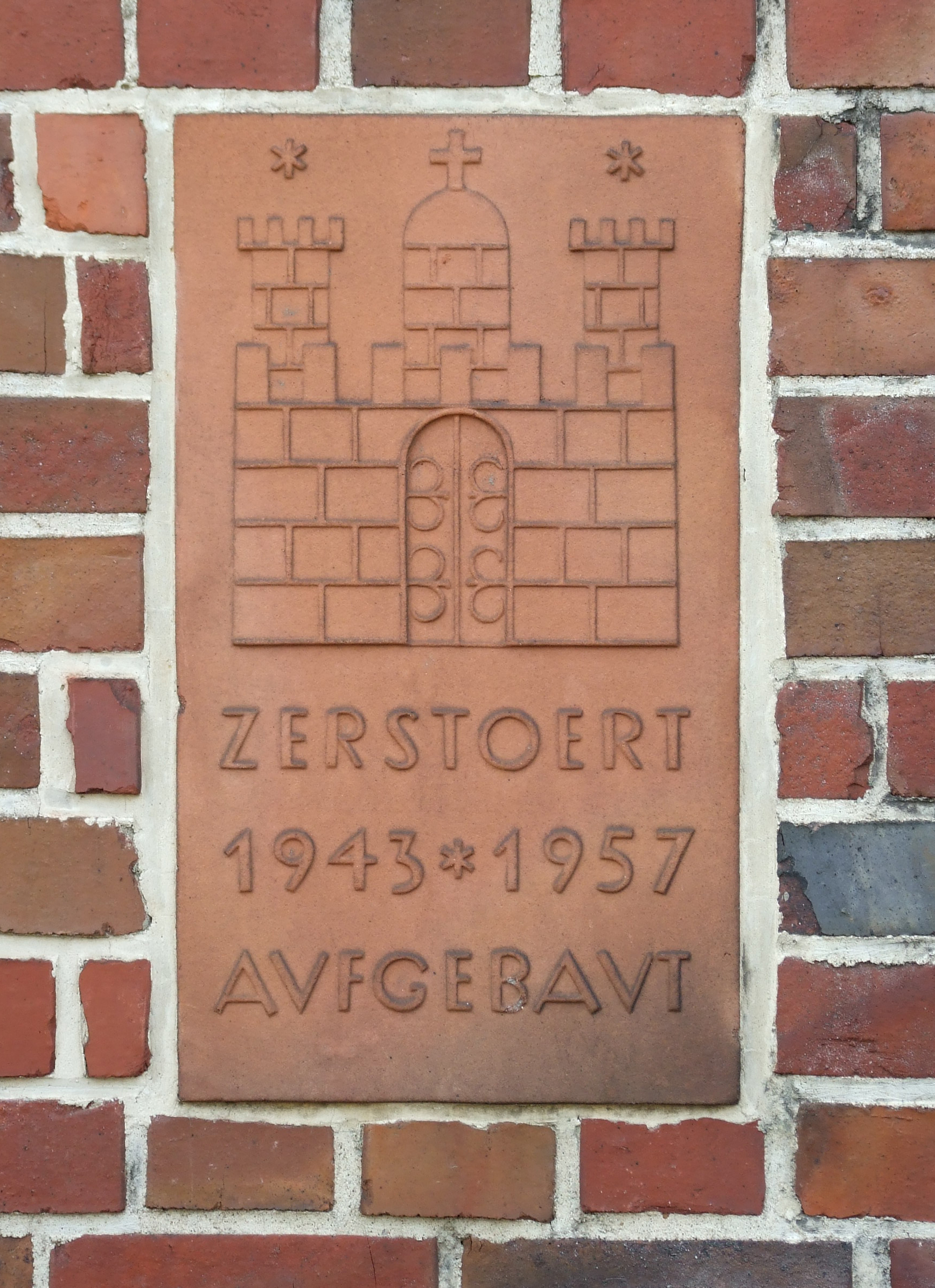
For example, many times when I would be walking around Hamburg, especially in residential areas, I would see these particular metal plaques on the facades of some red-bricked apartment buildings.
The plaques would read something like, “Destroyed 1943/Rebuilt 1955” or something like that.
And every time I would see these plaques, I would mostly think to myself, “Yeah, well, of course... Hamburg was bombed very badly during the war. Of course some houses got destroyed.”
But I recently read just how bad this city on the Elbe was actually bombed. A few weeks ago I picked up “Inferno: The Devastation of Hamburg, 1943,” and holy crap.
Usually, most people think that Dresden was the city most devastated by Allied bombings.
But the number of people killed in the Dresden bombings was somewhere between 18,000 and 25,000. The number of people who died during the Bombing of Hamburg, however, was about 42,000.
Shockingly, though, what makes the Bombing of Hamburg so terrible is not just the high casualty count. See, during the Bombing of Hamburg, which lasted about a week, from July 24 to August 3, 1943, the city was bombed nearly every single day.
But on the night of July 27th, the weather in the city was so dry and the Allied bombing so concentrated and accurate that a firestorm was created.
A firestorm is a humungous inferno that consumes everything in its path and is beyond human intervention. These blazes, which create and sustain their own wind systems, are so intense and suck up so much oxygen that the currents feeding them are as powerful as hurricane force winds.
As a result, after the Royal Air Force planes dropped their payloads that night, nearly every single building in an 8-square-mile section of the southeastern part of Hamburg burned.
According to “Inferno,” in this ground-zero zone, fires raged until the horizon in every direction, asphalt streets were turned into “flaming rivers of melted tarmac,” and fuel from destroyed ships spilled into canals, setting them alight, too.
And the human toll. Thousands of residents who had taken up shelter in their cellars died when smoke and poisonous gases from the fires outside poured into the supposed safe spaces.
Those lucky enough to have decided to try their luck on the streets had to brave blazing temperatures, dodge falling masonry and battle against storm-force winds as they tried to reach the city’s parks, the only refuge. Many people who allowed themselves to be pushed along by the winds, or couldn’t battle against them, were eventually swept into the fire.
As one Hamburger who, with this family who made the “good” decision that night of braving the streets to seek shelter in one of the city’s parks, recounts in the book:
[Once we got out onto the streets], we saw the first people burning, desperately running figures, who suddenly fell, and as we approached, were already dead. [Out on the street, on the way to the park], we had reached the first crossroads. Here we saw a building whose roof had, exceptionally, only just caught fire. In the entrance to this building we took shelter for a few moments from the storm, the heat, the whipping whirl of sparks and the glowing mounds of phosphor . . . Although we had only traveled a short distance, our lips were already badly swollen. Our throats were incredibly dry. Our legs felt weak . . .
All around, people fled from the burning buildings. Some came out with their clothes already alight; others caught fire outside from the sparks, the blazing heat or the phosphor. Again and again we saw burning people suddenly start to run, and soon after, to fall. After this, terrible cries were to be heard, but they, too, grew rarer. I saw many burning people who ran and collapsed in silence.
Though the raids continued on for a few more nights, with the British even again coming to bomb Hamburg as a thunderstorm raged over the city, on no other night were the bombings as intense as they were on the 27th.
In fact, a year after the war was over, Major Cortez F. Enloe, a surgeon in the United States Air Force who worked on the United States Strategic Bombing Survey, which sought to gauge just how effective the bombings in Germany had been, said that the fire effects of the atomic bomb dropped on Nagasaki "were not nearly as bad as the effects of the Royal Air Force raids on Hamburg on July 27th, 1943."
So do I take a little more time nowadays to think about what exactly I’m looking at when I see one of those memorial plaques on a redbrick apartment building in the city?
You bet I do.
Thursday, November 24, 2016
anniversary
Since
last Sunday marked the 1-year anniversary of those awful attacks in Paris, I
thought I’d share a small personal story with you. It’s about something that I
did on that very night, November 13, 2015, and I think it’s worth sharing.
When
the first shots rang out that night, I was in a movie. My
girlfriend and I had gone to see Woody Allen’s “Irrational Man” here in
Hamburg. The attacks in Paris began around 9:20 p.m. and by that time the movie
was about a quarter of the way through.
However,
that I can remember exactly where I was when the attacks began is not of any
interest. What’s interesting is something that happened before the movie began.
That’s what I’d like to talk about.
See,
the movie was to start at 8:45 p.m. at the Abaton Theater, which is an
independent theater that often plays films in English. The Abaton is located in
the Grindel, an area in Hamburg that has nice treelined streets and "altbau" apartments and used to be home to many of the city’s Jews.
Anyway,
I arrived at the Abaton early that night, around 8 p.m., which was fine. But
what wasn’t cool was that after I paid for the tickets, I noticed I had almost
no cash left. I decided to go to the bank, about four blocks away.
It
was November, so it was already dark and I remember that the night was cold. I
walked the blocks, passing a few small pubs, Middle Eastern eateries and a
small independent bookstore among other establishments.
At
one point, I came to an area where the sidewalk was very dark, probably because
there was scaffolding present. As I was walking by this area, I noticed that to
my left there was a homeless person sort of cuddled up against the façade of a
building. This person had many blankets on his lap and over his legs and he was
just sitting there.
As
I passed this person, I felt bad for him. Here was this guy, just sitting there
out in the cold and here I was, on my way to a Deutsche Bank to get money
because I wanted snacks for the movie.
I
felt like I had to do something. I told myself that I would give the guy a
little money on the way back. So after I made my withdrawal and started on my return
to the theater, I got my wallet out. But just as I did, something strange
happened. I decided I wouldn’t just give the guy 50 cents, which was the sum I
had planned on giving him. Instead, I would give him five euros.
Now,
over the years, I have given people on the street money. It’s usually never
more than one euro or one dollar. Maybe there was one time that I gave a person
more. But not usually. But for some reason, on this night, I spontaneously
decided to give this guy five euros. Something inside me just told me to.
I
think the guy said thank you after I deposited the bill in his cup, but I’m not
even sure.
Anyway,
I went on to see the movie, which was pretty funny, and only learned about the attacks
after I got home and turned on my computer. By then, though, it was all over. I
think my girlfriend and I stayed up late that night talking about terrorism.
Whatever
the case, one thing is for sure. I’m glad that I committed an act of kindness just
a few minutes – or half an hour, an hour, whatever it was – before those attacks
occurred.
I’m
not even exactly sure why I’m glad I committed an act of kindness right before
the attacks; I just kind of am. I guess it shows that even though there were
people in the world harboring hatred in their hearts that night, there were also people who were
filled with feelings of goodwill.
Sunday, October 16, 2016
Cash Rules Everything Around Me
Sometimes artistry just jumps out at you, when you’re
totally not expecting it.
Such was the case today when I was on the way home after having gone on a run.
I was walking on the street that leads to my house listening to my iPod when the song “C.R.E.A.M” by Wu Tang Clan came on.
I had always liked this song and I always knew the lyrics were pretty good – I had always especially liked the second verse, which talks about the hell of having to go through the prison system and being caught up in a vicious circle – but never really appreciated the first verse.
Until today. Listening to the song today on my way home, I realized that, just like the second verse, the first verse of the song is also really good. I especially appreciated the imagery in it. Anyhow, I'm going to reproduce the first verse below. I hope you like it too.
Such was the case today when I was on the way home after having gone on a run.
I was walking on the street that leads to my house listening to my iPod when the song “C.R.E.A.M” by Wu Tang Clan came on.
I had always liked this song and I always knew the lyrics were pretty good – I had always especially liked the second verse, which talks about the hell of having to go through the prison system and being caught up in a vicious circle – but never really appreciated the first verse.
Until today. Listening to the song today on my way home, I realized that, just like the second verse, the first verse of the song is also really good. I especially appreciated the imagery in it. Anyhow, I'm going to reproduce the first verse below. I hope you like it too.
I grew up on the crime side, the New York Times side
Staying alive was no jive
Had second hands, moms bounced on old man
So then we moved to Shaolin land
A young youth, yo rockin the gold tooth, 'Lo goose
Only way, I begin to G' off was drug loot
And let's start it like this son, rollin with this one
And that one, pullin out gats for fun
But it was just a dream for the teen, who was a fiend
Started smokin woolies at sixteen
And running up in gates, and doing hits for high stakes
Making my way on fire escapes
No question I would speed, for cracks and weed
The combination made my eyes bleed
No question I would flow off, and try to get the dough off
Sticking up white boys in ball courts
My life got no better, same damn 'Lo sweater
Times is rough and tough like leather
Figured out I went the wrong route
So I got with a sick tight clique and went all out
Catchin keys from across seas
Rollin in MPV's, every week we made forty G's
Yo brothas respect mine, or anger the tech nine
Ch-POW! Move from the gate now
Sunday, June 19, 2016
All you got
Sometimes giving it all you've got is as good as succeeding.
Such was the case with me recently when I attempted to have a small preview story published in local newspaper.
This story was about an art auction whose proceeds were to go toward helping refugees in Hamburg. The auction was going to take place on Sunday, so the story needed to be in the paper before that day.
However, I had totally forgotten that I wanted to write this story and when I finally did remember, I was absolutely nowhere near a computer
I know it's hard to believe that in today's day and age there was no computer to be found, but it was true.
So I knew what I had to do. I had to turn up my game and try a new approach.
I got out a spiral notebook and started drafting the story. And I mean drafting. After writing the story one time and getting it pretty much down, I rewrote the piece on another piece of paper -- a true second draft.
Then I did a third draft and a fourth. Then, because the newspaper I was pitching the piece to was a German language publication, I translated the piece into German. Then, I asked a friend who is bilingual if she could edit my translation and she did, again by good old pen and ink.
The next day, I was getting ready to type the 250-word piece into my phone and send it when someone told me that there was actually a computer in the place I was staying.
So I went over to where this computer was, but when I got there, lo and behold I discovered that the "public" computer was a money operated affair and I needed to have change to operate it. So I went to a store nearby, bought a cup of coffee, broke a 20 euro bill, came back to the computer and tapped out the piece.
Later that day, I got an email from the editor to whom I pitched the story. She said she liked the piece and thought she'd be able to squeeze it into the Saturday paper, but could I send a photo?
Because I was under the impression that I still had a tiny bit more time, I emailed my contact insteading of calling him to ask if he had a photo.
But it turned out that I probably should have called my contact. That's because by the time I got the photo, it was the next day, and by the time I got that photo to the editor, she told me I had missed the deadline for the Saturday paper.
As they say in German, "schade" -- "What a shame."
Yes, I was disappointed that the piece wouldn't be published, but you know what? After the editor gave me the bad news, I still felt all right. I went over in my mind all the things I had done -- all the hoops that I had jumped through to try to get this thing published -- and I felt a sense of pride.
The story is below. I don't know how good your German is, but if you want to plug it into Google translate and kind of see what you get, be my guest.
Eine Kunst-Auktion zugunsten der Flüchtlingshilfe wird am Sonntag den
19. Juni in Altona stattfinden. Das dadurch gesammelte Geld wird
verendet um syrischen und anderen Flüchtlingen in Hamburg zu helfen.
Die Auktion wird in der St. Petri Gemeinde Stattfinden und werden die
Gemälde von sechs lokalen Künstlern versteigert.
„Nachdem ich von freiwilligen Helfern der Flüchtlinge gehört hatte,
das jeder zusätzliche Euro gebraucht wird, wusste ich, dass ich etwas
machen wollte um zu helfen,“ sagte der Altonaer Künstler Volker Burk
(75), der die Idee zu der Auktion hatte.
Der Stil der Gemälde reicht von abstrakt über surrealistisch bis
minimalistisch. Die Gemälde werden voraussichtlich 150,- bis 200,-
euros pro Stück erzielen.
Die gesamten Erlöse der Auktion werden den Maltesern gespendet, einer
der vielen Organisation die den Flüchtlingen in Hamburg helfen.
Stefanie Langost, eine Mitarbeiterin der Malteser, sagte, dass das
gesammelte Geld aus der Auktion genutzt werden wird, um Kochkurse und
andere Kurse zur Verbesserung der Lebensqualität für rund 350
Flüchtlinge in Osdorf zu finanzieren.
Die Auktion am Sonntag beginnt um 17 Uhr. Die St. Petri Gemeinde liegt
in der Schmarjestraße 33.
Subscribe to:
Posts (Atom)