Saturday, January 13, 2018

Arm & Hammer

A former U.S. poet laureate once said that one quality that makes a great poem is specificity. As an example, he cited a poem about the culling of chickens and how the event was meticulously, even lavishly, described.

I really agree with his statement. If you look at great poems, one common denominator that they often have is that the objects and images described within them have been described accurately and with great specificity.

For example, just think about how well Wordsworth describes the abundance of daffodils in his poem “I Wandered Lonely as a Cloud”:

Continuous as the stars that shine
And twinkle on the milky way
They stretch in never ending line
Along the margin of a bay

Or how about how ominously Edgar Allen Poe depicts the raven:

And his eyes have all the seeming of a
demon’s that is dreaming,
And the lamp-light o’er him streaming
throws his shadow on the floor

There is certainly something about specificity that makes it an undisputed ingredient of good writing.

Enter Kevin Gates, a rapper from Baton Rouge, Louisiana. Kevin Gates is a badass, tattooed-covered dude who wears diamond studded fronts – or, a “mouth full of ice” – in many of his music videos. He had been or still is very involved in street life and has served time in prison on several occasions.
At first blush, he’s not the kind of guy one would think would have something in common with Wordsworth or Edgar Allen Poe.

But he does. It’s the writing. Yes, Gates lives in a totally different era from the other two writers and has quite the different lifestyle, but he too has written something that transcends the mundane, or even the good, thanks to specificity.

On his 2014 mixtape “By Any Means,” Gates has a song called “Arm and Hammer.” Yes, that’s the Arm & Hammer that your mom used to put in the refrigerator to absorb odors. However, drug dealers also use Arm & Hammer, which is really sodium bicarbonate, to turn cocaine into crack. Gates’ song of course refers to the latter usage. The main idea of the song is that the narrator is so successful as a drug dealer that he keeps running out of Arm & Hammer.

Now, of course I don’t condone drug dealing and drug use. But by zeroing in on this one object, Arm & Hammer, and its importance in the world of a drug dealer, Gates has written something that surpasses good and rises to the level of exceptional. By focusing on this one object – an object one would never think to write a song about or to make art about -- he really brings us vividly into his world.

Monday, December 25, 2017

Refugee story from 2015

During the summer of 2015, about a million refugees from war-torn Syria and the surrounding area came pouring into Germany. For journalists, especially in Germany, this was a big deal. I mean, tectonic plates were shifting and the influx of people created thousands of story opportunities. How, for example, were the refugees fitting in? Where were they being housed? What problems were they facing? How had the journey been? The opportunities for stories were endless. 
Now enter me. The only real thought I had to myself during this time, journalism-wise, was, "Dude, if you don't write at least a few stories off this, there is something wrong with you." Well, in the end I did write a few stories related to the refugee situation, but I'm most proud of the one below.
A bit of backstory: around Christmas 2015, I would always pass this one particular area at the main railway station in Hamburg. It was this makeshift command post for refugees who were just arriving or stuck in limbo or just needed some help. What struck me about this command post was how ragtag, yet efficient it seemed. They had translators at the place, supplies, bulletin boards, and there would always be people manning the area, even around the clock. 
I became intrigued about the people working at this station. Below is a story I wrote about them. I had sent the piece on spec to the Christian Science Monitor. Unfortunately, the editor there said, "We are pretty well covered on the subject," and passed. All right. But here the story is. I thought it was worth sharing, even if two years have elapsed.
***
For the last five months, a small brigade of volunteers working at a makeshift aid station at the Hamburg Central Train Station has been offering various forms of assistance to the droves of Syrian, Iraqi and Afghani refugees who have been passing through Hamburg on their way to Scandinavia to seek asylum.
The volunteers, most of whom are German citizens but some of them refugees themselves, translate for the newly arrived refugees, help them buy the proper train tickets and show them where they can get food and water. They also help the refugees solve the many unique problems that they face.
It has been well documented how kind and generous many Germans have been to the refugees who have been arriving in Germany from war-torn countries. But the aid station is a good representation of how grassroots and vigorous the effort to help the refugees often is.
“We just try to help the refugees however we can; the most important thing is that help is being given,” said Felix Brugger, 27, a volunteer at the aid station, which is located in the train station’s main entrance hall. Brugger made his comments after having just told two Afghani refugees which route they need to take to reach a particular city in Sweden.
Ever since last September, when Angela Merkel began allowing thousands of refugees to enter Germany, a couple hundred refugees have been arriving at the Hamburg Central Station each day.
Though the German government gives cash subsidies and other benefits to refugees who are in the process of seeking asylum in Germany, the refugees at the Hamburg train station are looking to go to Scandinavia, which means that the German government views them as “Transitflüchtlinge,” transit refugees, and does not give them any special support.
But that’s where the volunteers at the aid station come in. The volunteers -- there are about 40 of them in total and they work in shifts -- know which shelters are open for the night, keep detailed lists of the trains leaving for Scandinavia, escort the refugees around the train station and constantly stay abreast of the border situations in Scandinavia. They also raise money for the refugees, so if a refugee gets in a major jam, there’s cash on hand to help him get out of it.
“We try to make things easier for the refugees,” said one volunteer, Sumane, a 19-year-old Hamburg resident with Iraqi heritage.
Though the effort to help the refugees at the Hamburg Central Station seems robust and well coordinated, it wasn’t always that way.
Only a few people helped the refugees when they first began arriving at the train station in September. Those helpers, said Brugger, just handed out bottles of water and put makeshift barriers around an area where the refugees had been sitting to give them a little breathing room.
However, in mid-September, it was rumored that members of a far-right political party were going to hold an anti-immigration rally in Hamburg, and fears over how those protesters might treat the refugee if they encountered them at the train station galvanized more people into aiding the transit refugees.
“After that day in September,” Brugger said, “the effort to help the refugees here just got larger and more sophisticated.”
Indeed it did. In October, the volunteers got several humanitarian non-profit agencies to set up large tents with soup kitchens just outside one entrance to the train station, so all transit refugees now have access to free meals and an enclosed place to rest. And in December, the volunteers raised enough money to rent several rooms in a nearby office building so they can administer services to the refugees in a nicer environment, guarded from the elements and away from the hustle and bustle of the train station.
Though the number of refugees who pass through Hamburg on their way to Scandinavia has gone down since the winter began, it may rise again in the spring.
-->

Monday, July 24, 2017

Nail on the head


Ever notice how sometimes someone will say something that is so on point, you just have to say, “Yeah. Wow.”

Recently, I heard someone say something just like that, that really just hit the nail on the head.

I had been watching a video on YouTube about the history of the Air Jordan sneaker. The documentary was very positive about the shoe, but some criticisms were shared too.

One criticism was that people had been willing to commit violence to obtain a pair of Jordans. 

The person who shared this criticism was Dr. Harry Edwards, a former professor of sociology at U.C. Berkeley.

What made Edwards' words so insightful was that he didn’t just address the problem superficially. He tried to describe the underlying issue with American and consumerist culture at large. 

Here is what he said:

“The tragedies that took place between kids -- the killings, the assaults, over clothing as well as shoes -- was an indication of what we had taught as a culture. [And unfortunately] wearing the right clothes, identifying with the right image became some kids' sole hook and handle on their own personal self esteem.”

That about says it, I think. Yeah . . . Wow.

Friday, April 14, 2017

Desert Island Discs

A few weeks ago, I was searching iTunes for podcasts that involved Paul McCartney in any way. After a few minutes, I found one. It was called Desert Island Discs. Desert Island Discs, I learned, is a BBC show in which the guests have to tell a host which 10 songs they would bring with them to a desert island. A Desert Island Discs from 1982 featured Paul McCartney as the guest. 

After finding this episode, I downloaded it and played it on my computer. At first there was a bit of banter between McCartney and the host, but after that the two got down to business. Some of the songs that Paul said he would bring with him to the "desert island" were “Heartbreak Hotel,”  "Tutti Frutti," "Searchin'" by the Coasters and "Beautiful Boy" by John Lennon. 

I found this show very interesting. But what I found the most interesting was this: At the end of the episode, the host asked McCartney which one of those 10 songs he would bring with him if he could only choose one. 

And McCartney chose “Beautiful Boy” by John Lennon. 

Wow. 

Here’s a link to "Beautiful Boy"; here’s a link for more info on McCartney’s appearance on Desert Island Discs.


Saturday, February 11, 2017

art exhibition

A mural at the exhibition of refugee artwork at Harburg City Hall.
If you ask Sly Kristicevic what is particularly special about the new exhibition of refugee art on display at the Harburg City Hall, he has a ready answer: the colors.

Kristicevic, who has been leading art-making workshops for many of Hamburg’s refugees for almost two years and brought the current exhibition to fruition, said that when the refugees first started making art with him, their pieces often showed scenes of war and were nearly always black and white.

But, Kristicevic said, the refugees have seemed to grow more hopeful, and even though some works displayed at the exhibition reflect the difficulties and sorrows of refugee life, many of the pieces indeed have color and have a positive spin.

“This painting is supposed to show that you can always go higher and achieve more,” said Mohin, 13, who came to Hamburg from Afghanistan, as he pointed to a painting of his, which was on display and showed houses piled on one another to form a skyscraper of sorts.

About 25 works by roughly 15 artists are displayed at the exhibit. Though sorrow surely infuses some of the pieces –  a mural at the beginning of the exhibit, for example, shows the silhouettes of broken-looking people in a queue surrounded by barbed wire fences and a white paper-machete "ghost ship" bears the names of over a dozen people who died while trying to cross the Mediterranean -- most of the pieces really do have hopeful flare.
Mohin, 13, an artist represented at the exhibit, explains the meaning behind one of his paintings.

Said Anes Aromdany, 26, of Tunisa, whose painting, which was on display, was filled with swirling colors, had an angel in it and all together looked like something Marc Chagall could have painted: “I wanted to show [with this piece] that despite war, there is beauty in the world,  there is harmony...and balance is incredibly important in our universe and must be respected.”
Some of the artists drew pictures on the life vests they used on their journey across the Mediterranean Sea. Because some of the artists had bad associations with these vests — after all, the floating devices reminded them of a treacherous journey and had cost high sums to obtain — they wanted to make something positive out of them. The vest pictured here has the Eifel Tower among other things drawn on it.

The exhibition, which is aptly called "Farben Wieder Sehen, Leben Wieder Sehen" -- "Seeing Colors Again, Seeing Life Again" -- will run until February 17 and is free. Fördern und Wohnen, a city agency that helps find housing for people in need, organized the event; Harburg was one of its sponsors.

Kristicevic, for his part, said he hopes to put on more refugee artwork exhibitions but he is really just grateful to be able to continue making art with the refugees. "For me, he said, "it is a great blessing just to see these people smile again and to hear their beautiful stories again.”

Tuesday, January 24, 2017

A secret in the open

Sometimes, living in Germany, I experience some surreal moments. Here’s one. 

The other night I was sitting in a bar with two friends. I’m not going to reveal their real names, but let’s call them Hannah and Marie. Just so you know, I’m very close with Marie and, in confidence a year or so ago she told me that Hannah’s grandfather was, to use her words, “a very bad Nazi.”

Now, Hannah is very ashamed of this fact and would prefer that the fewer people who know it, the better. However, Marie couldn’t help but tell me, as she knows I am a WWII-history buff. Still, being the good friend she is, Marie told Hannah that she had told me. Now, Hannah and I have seen each other many times since Marie spilled the beans. But Hannah and I never openly discussed her infamous relative even though she knew I knew of his existence.

Well, we never discussed this relative of Hannah’s until the other night at the bar. What happened was, after having downed a few beers, the subject of Nazis somehow came up, and in the interest of just putting it all out there – and owing to the fact that I was a little buzzed – I decided to tell Hannah that I indeed did know who her Nazi relative was, that Marie had indeed told me.

However, I just wanted one slight clarification. “But this guy was your great-grandfather, right?” I said to Hannah, who was sitting across the table from me. I asked Hannah this question because Marie had always told me that Hannah’s grandfather was the culprit. But after having learned about this man, I had done a little googling and had discovered that Hannah’s grandfather would have been too young to fit the bill.

“‘Great-grandfather’ is ‘Urgroßvater' in German, right?" Hannah asked Marie, who’s English is better. 

“Right,” Marie said. 

“Then, yes," Hannah said, turning to me. "You're right."

There was a tiny pause. Trying to smooth things over and perhaps make the moment not as weighty, Marie turned to Hannah and said, “You shouldn’t feel that bad, though. I mean, my grandfather was actually in the Hitler Youth.”

“Yeah, but come on. The Hitler Youth,” Hannah replied, and in doing so gave me a look.  

Now, I gotta say, in this moment, this look that Hannah gave to me said everything. Essentially, with this look, Hannah was totally pooh-poohing Marie’s comment about her grandfather having been in the Hitler Youth because being in the Hitler Youth just meant that you were a tiny dot in the Nazi universe. 

Hannah’s great-grandfather, however, was something much larger. He was actually an SS commander and had been in charge of crushing a major anti-Nazi uprising, a task that resulted in the deaths of thousands of people. 

After Hannah made her “But come on, the Hitler Youth” comment, we all kind of dropped the subject. But, really, I can't emphasize enough how much had been revealed in that 
quick look Hannah had given me. It was like she was trying to convey this: The Hitler Youth? That’s nice and all, but if you actually looked up exactly what my great-grandfather was responsible for, well, maybe you’d be singing to a different tune.

And then we all ordered another drink at this nice trendy bar in Hamburg.

I’m telling you, some very trippy experiences you have here in Germany sometimes.

Friday, January 20, 2017

I Just Emailed to Say...

One thing that my mom and I have in common is that we both like words. She was an English teacher and has a master's in American Literature and just really appreciates the well crafted poem, story, sentence. So sometimes, I write to her, telling her things that I like and asking her opinion on them and then we discuss it. Sometimes, I hear things, songs, maybe an article, that she likes and then point her in the direction of it. Anyway, below is an email I wrote to her recently, telling her about a song I've rediscovered and a section of it that I thought she would particularly like. I thought the email was interesting enough to post. I hope you do too.

Hi Ma,

I just wanted to write to you because I heard something the other day that I thought you would like too.
Because I've been very much into song writing lately, I've been very conscious of how songs are structured/their lyrics.
Anyway, did you ever realize how nice the song "I Just Called to Say I Love You" is?
What's interesting is that for the entire verses, he's saying reasons why he is NOT calling. For example: "No New Years Day to Celebrate ...  No first of spring ... No flowers bloom," etc. I thought that was a nice paradoxical twist.
But I'm actually brining this song to your attention because I thought you'd particularly like the second verse, which starts, "No summer's high."
I'll reproduce the rest of the verse here, but I suggest you listen to the song first, then look at the lyrics. 
Let me know what you think!
-me
No summer's high 
No warm July
No harvest moon to light one tender August night
No autumn breeze
No falling leaves
Not even time for birds to fly to southern skies


Wednesday, December 28, 2016

A bit of untangling

You know those songs that just get you every time? The ones you never get tired of listening to? For me, Jim Croce’s “Time in a Bottle” is one of those songs. I hardly ever skip it when my iPod cues it up; it’s that beautiful. The melody, the lyrics: “If I could save time in a bottle/The first thing that I’d like to do/Is to save every day/'Til eternity passes away/Just to spend them with you.”

The lyrics are great and really force you to think about life and how you’re spending your time. But there has always been one set of lyrics in this song that I could not get my head around, so I figured I’d parse them here for fun.

Around the middle of the song, Croce starts singing about his wishes and dreams that have and haven’t come true. It is these particular lyrics that lead to some confusion. Croce sings: “If I had a box just for wishes and dreams that had never come true, the box would be empty except for the memory of how they were answered by you.”

Uh, what? You know, one tenet of writing is avoid using negatives, especially double negatives. For example, it’s bad form to write, “That’s not something I don’t like.” Such a sentence causes unnecessary confusion.

Well, if that’s true, then Croce definitely violates some rules with his lyric. I mean, “If I had a box just for wishes and dreams that had never come true? The box would be empty except for the memory of how they were answered by you”?

Every time I've heard this lyric, I've been like, “Wait...what?” But to be honest, it sounds like Croce is trying to convey something beautiful and deep, so let’s see if we can deconstruct the line. OK, so, first off, “If I had a box just for wishes and dreams that had never come true, the box would be empty...”

All right, I think I get that. If Croce had a box that contained both wishes and dreams of his that had never come true this box would be empty. That means all his wishes and dreams have come true. Yippee!  

But wait. In the next breath, he actually says that this box of wishes and dreams that had never come true “would be empty except for the memory of how they were answered by you.”

OK, so in my mind, at the end of the day, all the lyric essentially means is this: In my imagined box of wishes and dreams that have never come true, there is just one “item," and that's the memory of how my wishes and dreams were answered by you. This memory of my wishes and dreams being answered by you would be in this box of "wishes and dreams that never came true" because I don’t have this memory. I wish I did, but I don't.  You never answered, or fulfilled, my wishes and dreams, woman!

Basically, I got all I wanted in life, but I didn’t get what I wanted from you. Crazy, line, huh? I guess the bottom line is this: Avoid writing in the negative.


If I had a box for wishes and dreams that had come true, the box would be nearly filled, but the one thing missing would be the memory of how you answered these wishes and dreams of mine.


Thursday, December 15, 2016

The Bombing of Hamburg

You know, it’s interesting how we sometimes perceive things differently after having learned a little bit.
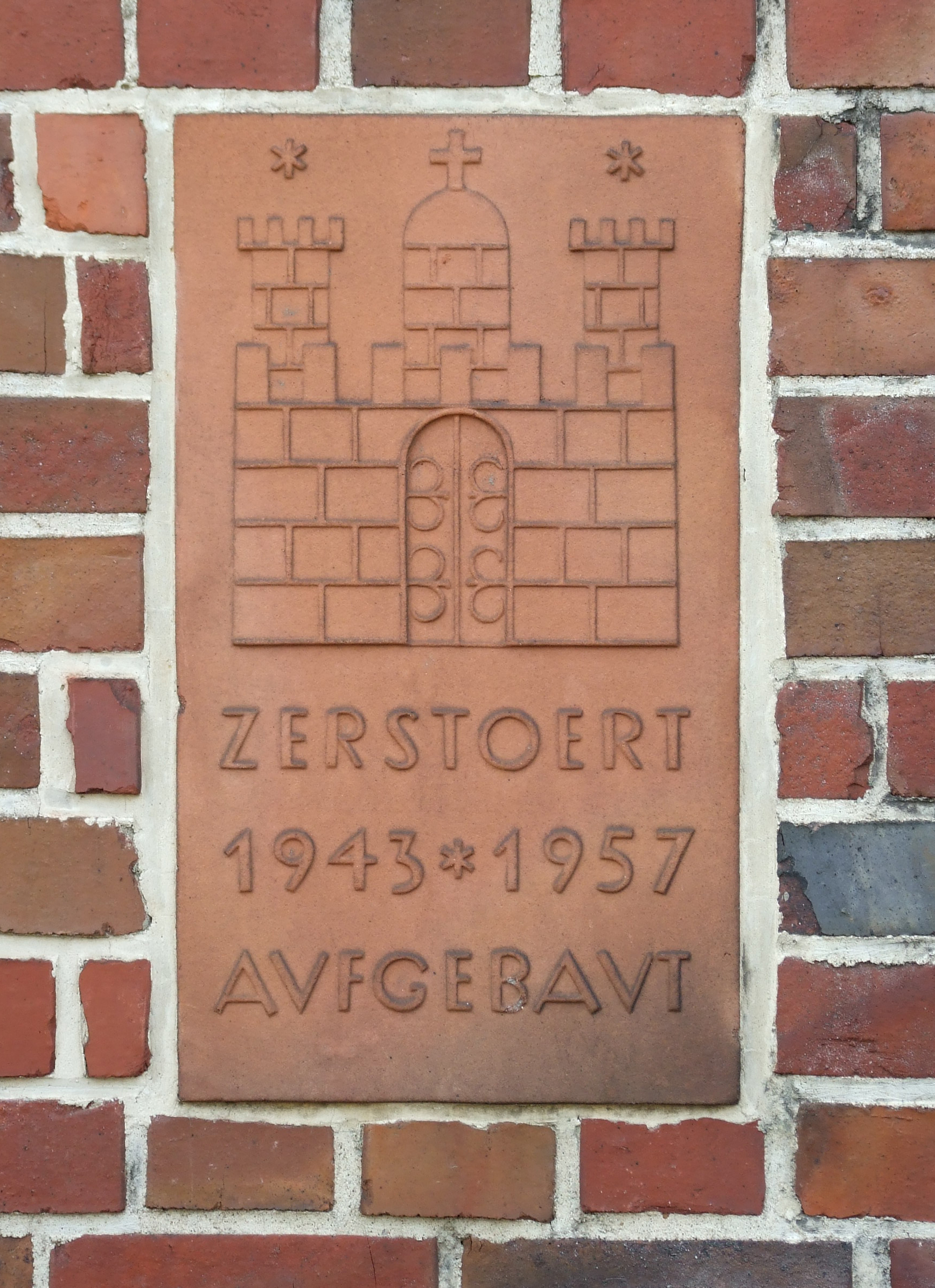
For example, many times when I would be walking around Hamburg, especially in residential areas, I would see these particular metal plaques on the facades of some red-bricked apartment buildings.
The plaques would read something like, “Destroyed 1943/Rebuilt 1955” or something like that. 
And every time I would see these plaques, I would mostly think to myself, “Yeah, well, of course... Hamburg was bombed very badly during the war. Of course some houses got destroyed.”
But I recently read just how bad this city on the Elbe was actually bombed. A few weeks ago I picked up “Inferno: The Devastation of Hamburg, 1943,” and holy crap.
Usually, most people think that Dresden was the city most devastated by Allied bombings. 
But the number of people killed in the Dresden bombings was somewhere between 18,000 and 25,000. The number of people who died during the Bombing of Hamburg, however, was about 42,000.
Shockingly, though, what makes the Bombing of Hamburg so terrible is not just the high casualty count. See, during the Bombing of Hamburg, which lasted about a week, from July 24 to August 3, 1943, the city was bombed nearly every single day.
But on the night of July 27th, the weather in the city was so dry and the Allied bombing so concentrated and accurate that a firestorm was created. 
A firestorm is a humungous inferno that consumes everything in its path and is beyond human intervention. These blazes, which create and sustain their own wind systems, are so intense and suck up so much oxygen that the currents feeding them are as powerful as hurricane force winds.
As a result, after the Royal Air Force planes dropped their payloads that night, nearly every single building in an 8-square-mile section of the southeastern part of Hamburg burned. 
According to “Inferno,” in this ground-zero zone, fires raged until the horizon in every direction, asphalt streets were turned into “flaming rivers of melted tarmac,” and fuel from destroyed ships spilled into canals, setting them alight, too.  
And the human toll. Thousands of residents who had taken up shelter in their cellars died when smoke and poisonous gases from the fires outside poured into the supposed safe spaces.
Those lucky enough to have decided to try their luck on the streets had to brave blazing temperatures, dodge falling masonry and battle against storm-force winds as they tried to reach the city’s parks, the only refuge. Many people who allowed themselves to be pushed along by the winds, or couldn’t battle against them, were eventually swept into the fire.
As one Hamburger who, with this family who made the “good” decision that night of braving the streets to seek shelter in one of the city’s parks, recounts in the book:
[Once we got out onto the streets], we saw the first people burning, desperately running figures, who suddenly fell, and as we approached, were already dead. [Out on the street, on the way to the park], we had reached the first crossroads. Here we saw a building whose roof had, exceptionally, only just caught fire. In the entrance to this building we took shelter for a few moments from the storm, the heat, the whipping whirl of sparks and the glowing mounds of phosphor . . . Although we had only traveled a short distance, our lips were already badly swollen. Our throats were incredibly dry. Our legs felt weak . . .
 All around, people fled from the burning buildings. Some came out with their clothes already alight; others caught fire outside from the sparks, the blazing heat or the phosphor. Again and again we saw burning people suddenly start to run, and soon after, to fall. After this, terrible cries were to be heard, but they, too, grew rarer. I saw many burning people who ran and collapsed in silence.
Though the raids continued on for a few more nights, with the British even again coming to bomb Hamburg as a thunderstorm raged over the city, on no other night were the bombings as intense as they were on the 27th.
In fact, a year after the war was over, Major Cortez F. Enloe, a surgeon in the United States Air Force who worked on the United States Strategic Bombing Survey, which sought to gauge just how effective the bombings in Germany had been, said that the fire effects of the atomic bomb dropped on Nagasaki "were not nearly as bad as the effects of the Royal Air Force raids on Hamburg on July 27th, 1943." 
So do I take a little more time nowadays to think about what exactly I’m looking at when I see one of those memorial plaques on a redbrick apartment building in the city? 
You bet I do.
-->

Thursday, November 24, 2016

anniversary

Since last Sunday marked the 1-year anniversary of those awful attacks in Paris, I thought I’d share a small personal story with you. It’s about something that I did on that very night, November 13, 2015, and I think it’s worth sharing.
When the first shots rang out that night, I was in a movie. My girlfriend and I had gone to see Woody Allen’s “Irrational Man” here in Hamburg. The attacks in Paris began around 9:20 p.m. and by that time the movie was about a quarter of the way through.
However, that I can remember exactly where I was when the attacks began is not of any interest. What’s interesting is something that happened before the movie began. That’s what I’d like to talk about.
See, the movie was to start at 8:45 p.m. at the Abaton Theater, which is an independent theater that often plays films in English. The Abaton is located in the Grindel, an area in Hamburg that has nice treelined streets and "altbau" apartments and used to be home to many of the city’s Jews.
Anyway, I arrived at the Abaton early that night, around 8 p.m., which was fine. But what wasn’t cool was that after I paid for the tickets, I noticed I had almost no cash left. I decided to go to the bank, about four blocks away.
It was November, so it was already dark and I remember that the night was cold. I walked the blocks, passing a few small pubs, Middle Eastern eateries and a small independent bookstore among other establishments.
At one point, I came to an area where the sidewalk was very dark, probably because there was scaffolding present. As I was walking by this area, I noticed that to my left there was a homeless person sort of cuddled up against the façade of a building. This person had many blankets on his lap and over his legs and he was just sitting there.
As I passed this person, I felt bad for him. Here was this guy, just sitting there out in the cold and here I was, on my way to a Deutsche Bank to get money because I wanted snacks for the movie.
I felt like I had to do something. I told myself that I would give the guy a little money on the way back. So after I made my withdrawal and started on my return to the theater, I got my wallet out. But just as I did, something strange happened. I decided I wouldn’t just give the guy 50 cents, which was the sum I had planned on giving him. Instead, I would give him five euros.
Now, over the years, I have given people on the street money. It’s usually never more than one euro or one dollar. Maybe there was one time that I gave a person more. But not usually. But for some reason, on this night, I spontaneously decided to give this guy five euros. Something inside me just told me to.
I think the guy said thank you after I deposited the bill in his cup, but I’m not even sure.
Anyway, I went on to see the movie, which was pretty funny, and only learned about the attacks after I got home and turned on my computer. By then, though, it was all over. I think my girlfriend and I stayed up late that night talking about terrorism.
Whatever the case, one thing is for sure. I’m glad that I committed an act of kindness just a few minutes – or half an hour, an hour, whatever it was – before those attacks occurred.
I’m not even exactly sure why I’m glad I committed an act of kindness right before the attacks; I just kind of am. I guess it shows that even though there were people in the world harboring hatred in their hearts that night, there were also people who were filled with feelings of goodwill. 

Sunday, October 16, 2016

Cash Rules Everything Around Me

Sometimes artistry just jumps out at you, when you’re totally not expecting it.

Such was the case today when I was on the way home after having gone on a run.

I was walking on the street that leads to my house listening to my iPod when the song “C.R.E.A.M” by Wu Tang Clan came on.

I had always liked this song and I always knew the lyrics were pretty good – I had always especially liked the second verse, which talks about the hell of having to go through the prison system and being caught up in a vicious circle – but never really appreciated the first verse.

Until today. Listening to the song today on my way home, I realized that, just like the second verse, the first verse of the song is also really good. I especially appreciated the imagery in it. Anyhow, I'm going to reproduce the first verse below. I hope you like it too. 
I grew up on the crime side, the New York Times side
Staying alive was no jive
Had second hands, moms bounced on old man
So then we moved to Shaolin land
A young youth, yo rockin the gold tooth, 'Lo goose
Only way, I begin to G' off was drug loot
And let's start it like this son, rollin with this one
And that one, pullin out gats for fun
But it was just a dream for the teen, who was a fiend
Started smokin woolies at sixteen
And running up in gates, and doing hits for high stakes
Making my way on fire escapes
No question I would speed, for cracks and weed
The combination made my eyes bleed
No question I would flow off, and try to get the dough off
Sticking up white boys in ball courts
My life got no better, same damn 'Lo sweater
Times is rough and tough like leather
Figured out I went the wrong route
So I got with a sick tight clique and went all out
Catchin keys from across seas
Rollin in MPV's, every week we made forty G's
Yo brothas respect mine, or anger the tech nine
Ch-POW! Move from the gate now

Sunday, June 19, 2016

All you got


Sometimes giving it all you've got is as good as succeeding.

Such was the case with me recently when I attempted to have a small preview story published in local newspaper.

This story was about an art auction whose proceeds were to go toward helping refugees in Hamburg. The auction was going to take place on Sunday, so the story needed to be in the paper before that day.

However, I had totally forgotten that I wanted to write this story and when I finally did remember, I was absolutely nowhere near a computer

I know it's hard to believe that in today's day and age there was no computer to be found, but it was true.

So I knew what I had to do. I had to turn up my game and try a new approach.

I got out a spiral notebook and started drafting the story. And I mean drafting. After writing the story one time and getting it pretty much down, I rewrote the piece on another piece of paper -- a true second draft.

Then I did a third draft and a fourth. Then, because the newspaper I was pitching the piece to was a German language publication, I translated the piece into German. Then, I asked a friend who is bilingual if she could edit my translation and she did, again by good old pen and ink.

The next day, I was getting ready to type the 250-word piece into my phone and send it when someone told me that there was actually a computer in the place I was staying.

So I went over to where this computer was, but when I got there, lo and behold I discovered that the "public" computer  was a money operated affair and I needed to have change to operate it. So I went to a store nearby, bought a cup of coffee, broke a 20 euro bill, came back to the computer and tapped out the piece.

Later that day, I got an email from the editor to whom I pitched the story. She said she liked the piece and thought she'd be able to squeeze it into the Saturday paper, but could I send a photo?

Because I was under the impression that I still had a tiny bit more time, I emailed my contact insteading of calling him to ask if he had a photo.

But it turned out that I probably should have called my contact. That's because by the time I got the photo, it was the next day, and by the time I got that photo to the editor, she told me I had missed the deadline for the Saturday paper.

As they say in German, "schade" --  "What a shame."

Yes, I was disappointed that the piece wouldn't be published,  but you know what? After the editor gave me the bad news, I still felt all right. I went over in my mind all the things I had done -- all the hoops that I had jumped through to try to get this thing published -- and I felt a sense of pride.

The story is below. I don't know how good your German is, but if you want to plug it into Google translate and kind of see what you get, be my guest.

 Eine Kunst-Auktion zugunsten der Flüchtlingshilfe wird am Sonntag den
19. Juni in Altona stattfinden. Das dadurch gesammelte Geld wird
verendet um syrischen und anderen Flüchtlingen in Hamburg zu helfen.

Die Auktion wird in der St. Petri Gemeinde Stattfinden und werden die
Gemälde von sechs lokalen Künstlern versteigert.

„Nachdem ich von freiwilligen Helfern der Flüchtlinge gehört hatte,
das jeder zusätzliche Euro gebraucht wird, wusste ich, dass ich etwas
machen wollte um zu helfen,“ sagte der Altonaer Künstler Volker Burk
(75), der die Idee zu der Auktion hatte.

Der Stil der Gemälde reicht von abstrakt über surrealistisch bis
minimalistisch. Die Gemälde werden voraussichtlich 150,- bis 200,-
euros pro Stück erzielen.

Die gesamten Erlöse der Auktion werden den Maltesern gespendet, einer
der vielen Organisation die den Flüchtlingen in Hamburg helfen.

Stefanie Langost, eine Mitarbeiterin der Malteser, sagte, dass das
gesammelte Geld aus der Auktion genutzt werden wird, um Kochkurse und
andere Kurse zur Verbesserung der Lebensqualität für rund 350
Flüchtlinge in Osdorf zu finanzieren.

Die Auktion am Sonntag beginnt um 17 Uhr. Die St. Petri Gemeinde liegt
in der Schmarjestraße 33.

Sunday, May 08, 2016

Transmission


Someone recently asked me what I like about writing. Well, many things, I told him, but one thing in particular is the transmission. I like to write because in doing so you can transmit things – images, sounds, feelings – to people. You can bring people to places they wouldn’t or couldn’t otherwise go. I’m trying to do a little transmitting with this post. Enjoy.

*Look up into the clear blue sky. Do you see that propeller plane with a banner tied to its tail wing? Can you read the banner? Is it an advertisement or is the message personal? 

*Do me a favor and come over here to the kitchen table. See the candle burning in the small jar? Put your palm over the flame. Yes, of course, make sure your palm is at a safe distance from the flame. But do you feel the heat? You notice, of course, how the heat increases when you move your palm closer to the flame. Blow out the candle. Don’t you love how the smoke curls up like that? Look at the wick. Notice how the tip of it is still burning a tiny bit? Blow on it and it will glow a slightly more intense orange for a second.

*Check out this photo of John Lennon. It was taken in Hamburg in 1960. Lennon is 20 years old in it. Look at his leather jacket and rockabilly hairstyle. Look at that knowing expression on his face. Lennon is in “Heiligengeistfeld,” which is basically a massive concrete lot in the middle of Hamburg. The lot is usually used to host carnivals. Anyway, look behind John Lennon. Do you see that blurred figure holding a bass guitar? That’s Stuart Sutcliffe. He was a member of the Silver Beatles, the first incarnation of what would later become the Beatles. Do you see that huge concrete structure behind him, there all the way in the background? That’s a bunker from World War II. The Nazis erected hundreds of bunkers around Hamburg and the one in this picture still stands.

*Get on the bus. No, don’t go up front and show your ticket to the bus driver. Just enter one of the side doors. Don’t sit down. Just grab onto this overhead handle. Are you secure? Good. Now look down at the floor. Do you see that intact cigarette? How did it get there? Just one single cigarette that hasn’t been smoked. Cigarettes don’t come cheap these days. It must have fallen out of someone’s pack or pocket. And now it’s just lying there. What do you think, will someone pick it up and smoke it? My money is on someone will.

*What are you doing? Do you have time to listen to something cool? Come outside. Do you hear those bells? Yeah, there are bells fixed to that building right there on the corner, and every hour they play a tune. Yes, yes, that is “Yesterday.” I know, it sounds a little funky, maybe a little off or something, but that is “Yesterday.” You can hear it, right? I believe in yesterday. Isn’t it crazy that a song written by Paul McCartney in 1966 is played by a bunch of bells that have been affixed to a building in Hamburg and are programmed to play a song every hour? I mean, where else is that song played every day? In how many department stores and supermarkets? In how many elevators? Yes, that absolutely is "Yesterday." I believe in yesterday.

*Do you see that woman holding a baby? She’s walking into the supermarket right now. At first you didn’t notice that she was holding a baby, right? If you were like me, the first thing you noticed was her short shorts and those tattoos. You don’t see? She’s got a five pointed star tattooed on the back of each of her upper thighs. It’s like some kind of rock-n-roll sexy thing, I don’t know. But, yeah, she’s holding a baby. I think it's swaddled in some kind of wrap that's tied to her neck.

*Do you hear that warbling and chirping? Those are the birds that live in the trees that line the street. You don’t see those birds, but they are there, singing and chirping and twittering away. When can you expect to hear their tunes? Around sunrise and sunset.

Tuesday, May 03, 2016

A visitor in the gazebo

So my girlfriend and I had a very interesting interaction with a stranger today.

It all started when we went to the park to walk our dog. Because it was raining, we decided to head over to an area in the park where there was a gazebo.

We were sitting on a bench in the gazebo, just chatting — there was hardly anyone else in the park because it was coming down pretty hard — when a small guy with caramel skin entered our vicinity.

The guy was wearing a heavy coat and had a wine bottle in one hand, and the first thing I thought to myself when I saw him was “Oh no, here comes trouble.”

He walked into the gazebo and began talking to us, but it wasn’t in German. He was speaking French.

“Joli chien,” he said and pointed to our dog. I just nodded and smiled. My girlfriend knows a little French and is currently taking a French course, so she said something back to him.

Though I didn’t understand what he or she was saying, I was able to gather quickly that this guy didn’t mean any harm. And since I knew that he was going to be more interested in talking with my girlfriend, I figured I would just observe.

He put his wine bottle down on the gazebo’s cement floor and again took interest in my dog, a grey Weimaraner.

“Joli,” he said and petted the dog. He then said a few things that neither my girlfriend nor I understood. When my dog walked away and returned with a stick, he picked it up and made a gesture as if he would throw it.

“Puis-je jeter le bâton?”

We nodded and he threw the stick toward a childrens play area, which was nearby. The man then asked my girlfriend if she spoke French. Though she said, ‘juste un petit peu,’ he replied to her with a quick and abundant stream of words. Despite our inability to understand the majority of what he had said, we were able to gather at least that he was from Dijon.

He then said something that I was able to piece together, “Le monde entier sait Dijon à cause de notre senf.”

I knew that “le monde” meant “the world” and that in German “senf” meant mustard, so I was almost sure he had said something like, “The whole world knows Dijon because of our mustard.”

When the dog returned, he said, “Ceci est un bon chien.” My dog had dropped the stick right by his feet and was looking directly up at him, indicating that she wanted him to throw it again.

“Le chien a fait un nom français,” – the dog has a French name – my girlfriend said. Though the man didn’t seem to notice that she had said this, when she said, “Filou. Le nom du chien est Filou,” he snapped to attention. “Ah, Filou,” he said.

He then said a bunch of things that my girlfriend didn't understand. Miraculously, though, somewhere in the middle of all that he had said, I heard the words “pit bull.”

“Oh, pit bull!” I said. “Oui, oui, pit bull,” he replied and looked at me. He had a thick black beard made up of straight black hairs and his eyes were a shade lighter than his skin.

He then said something in French that I didn’t understand except for the word “malady.” Once I heard that word, though, I said, “Oh, sick, malady.” “Oui, oui," he said, "malady.”

He then held up four fingers and in German said, “ende.” We gathered that he was telling us that he once had a dog and that dog had died at age four from a sickness.

My girlfriend expressed her sympathy and then pointed down to Filou, who had rain drops on her forehead and was hunching her back, expectedly waiting for the guy to throw the stick again. “Trois,” she said.

“Ah, trois,” the man said, pointing to the dog. He then picked up the stick and with an excited and mischievous look in his eyes told my girlfriend to go pick up another stick. She complied and he then told her, or more like gestured to her, that on his signal she should run from him in the opposite direction.

When he gave the signal, Filou followed her and at this moment, the man took off with his stick and attempted to hide it from Filou. But the dog was too smart, noticed what was going on and immediately switched her course and ran toward him.

“Non!” he laughed when Filou caught up with him by the childrens play area. Filou tried to grab the stick but the moment she made a move for it, he threw it as far as he could. He and my girlfriend then came back to the gazebo.

“Ç’est froid,” it’s cold, my girlfriend said. “Oui, froid,” he replied. “But,” she said, “you’ve got your wine.” At this he took slight offence. He said that it wasn’t wine he was drinking but another kind of liquor. To me it looked like a bottle of white wine.

“Cette boisson est forte,” he said and then turned the bottle to show us the label, which said that the beverage was 11 percent alcohol by volume.

 He then opened the bottle and took a sip. After that, he said something in French that my girlfriend and I did not understand. When he saw we were lost, he pointed to the roof of the gazebo and then made a wagging gesture with his pointer finger to indicate “no.”

“You don’t have a home?” my girlfriend said in English. “No,” he said, “no home.” Then in French and a tiny bit of German, he told us that because he is French, the German government won’t give him any subsidies or benefits. “Ils me disent qu'ils ne peuvent pas me aider parce que je suis français.”

He then said something about being French and how he always has his French passport ready if the police harass him.

When Filou returned with the stick and dropped it on the gazebo floor, we all had to laugh at how consistent she was. When the man again threw the stick, he said something in French that sounded mirthful.

By this point, though, I was very cold — it was a cold, rainy day in Hamburg, after all — and when my girlfriend told me that she was cold, too, I asked her if she wanted to go. When she said that she did, I stood up and zipped my coat up all the way.

The guy saw that we wanted to leave but said he wanted to show us something first and it was at that point that I realized how difficult his situation must have been.

He unzipped that big coat of his and underneath it was another coat. And under that was a huge fleece zip up. And under that was yet another coat. And in the pocket of that last coat was his passport. He wanted to show us his passport, but I couldn’t help but notice that his attire was definitely consistent with someone who lives on the street.

“Je suis un Français,” he said. He then pointed to his name on his passport and we repeated it just to make sure that we got it right. As we were doing this, my girlfriend noticed that he had just had a birthday two days prior. “Oh, it was your birthday,” she said. “Oui, oui,” he replied.

“Herzlichen glückwunsch,” I said, thinking that maybe he would recognize those words. He didn’t and he didn’t understand “congratulations” either. But when I gave him a thumbs-up and pointed at his birth date on his passport, he smiled and rolled his eyes, like “of course!” “Je comprends,” he said.

We all began to walk out of the gazebo and as we did he said something to my girlfriend in a lower tone. “Oh, yes, OK,” she said. She then took out her wallet and gave him the rest of the change that she had. I looked in his hand after she gave him the money and saw that she had given him about one euro and 60 cents.

When we parted from the guy, I said to my girlfriend, “Geeze, a euro sixty. I don’t think you’ve ever given that much money to any person on the street before.”

“Yeah, what can I say,” she said. “He needs it. And he played with Filou all that time and I got to practice my French. It was worth it.”

I nodded. “Yeah," I said. "I liked that guy...There was something about his vibe that I liked.”

Wednesday, April 27, 2016

The nicest act of kindness

Here is something I wrote in my personal journal. Enjoy. 

I witnessed the nicest act of kindness a few minutes ago.

I was walking down a street here in Hamburg called Steintordamm when I witnessed this act of kindness.

Steintordamm is near the Hamburg Central Station. More specifically, it’s near the southern entrance of the central station, which is known as "Hauptbahnhof Süd."

Hauptbahnhof Süd, to be frank, is kind of seedy. Usually, one can find all kinds of "interesting" people there.

Anyway, as I was walking down Steintordamm near Hauptbahnhof Süd, I saw a man completely passed out on the sidewalk. As I approached him, I didn’t think much of what I was seeing. I mean, I did think that he was in pretty bad condition, as he was totally laid out on the pavement. But for the most part, I thought that what I was seeing fit the bill for this part of town.

I was ready just to pass this guy like it was any other day, and that’s when it happened – the nicest act of kindness.

A teenage girl who was approaching the man from the opposite direction that I was knelt down beside him and put some change near his hand. 

After the girl got back to a standing position, I tried to make eye contact with her to express my approval, but she didn’t make eye contact with me.

I thought she was very kind for giving the man money, but it was only until I actually walked past the man and saw how much she gave him that I was really impressed.

There, next to his dirt caked fingers were three euros.

The man was just lying there, completely passed out, not doing anything to try to earn the money, not giving any sob story, not even holding up a sign...and then this girl, a girl who for whatever reason found it in herself to shell out money to a man who would never know who she was and could not thank her for her generosity. 

It was the nicest act of kindness.

Saturday, April 02, 2016

outsider

Recently someone asked me if I was accustomed to living in Germany. I told the person I was because for the most part, I am. But today I had an experience that made me realize that I really am an outsider, that this is not my country and Germany is something I can only try to understand.

I was lying in my bed around 7 a.m. when I suddenly heard the sound of my next-door neighbor’s TV. But instead of hearing something recognizable, something that I might hear on T.V. in the United States around 7 a.m., I heard something else. An old German ballad. See, my neighbor was watching what sounded like a classic German film and in it, an actor was crooning.

As I lied there and listened to the actor singing, I realized that I was listening to a song I had never before heard and that this song belonged to a movie I had never before seen. I also realized that even if I was told the name of the movie, I would probably have no idea what the significance of it was or why someone would want to watch it, or watch it again, at 7 a.m.

Now, if I would have heard “Casablanca” coming from my neighbor’s apartment, I might have thought to myself that my neighbor was nostalgic for movies that came out while America was in the grips of World War II, or if I would have heard the “Wizard of Oz," coming from his apartment, I might have thought that maybe my neighbor used watch to the “Wizard of Oz” with his parents or with a grandparent and he just wanted to watch it again.

But I had no idea why my neighbor wanted to watch the film he was watching because I had nothing to anchor onto. The actors’ voices were not familiar and neither was the song.

Which sort of brings me to my next point. Had the lyrics of the song that the actor was singing been in English, I might have been able to understand what the movie was generally about and why my neighbor wanted to watch it. But the actor was singing in German, and I didn’t understand the lyrics. 

And as I lied there and listened to that song, whose lyrics I didn’t understand, in a country that was not my own, I was humbled.

Friday, March 18, 2016

Objects from my childhood

I was walking in a park with my girlfriend the other day when she asked me a strange question: “Are there free water fountains in New York City?” she wanted to know.

For a second, I wasn’t sure. I have been living in Germany for so long now, it’s sometimes hard to remember such things. But eventually the answer came to me.

“Yeah,” I said. “We’ve got free water fountains. But they’re usually in parks.”

“Oh, OK, that’s cool,” she said.  “I just wanted to know because my university is thinking of installing water fountains. I was just curious.”

I said that that was fine but for some reason didn’t drop the subject. “Yeah,” I continued, “the water fountains we had in our parks in New York City were rock solid. They were usually made of stone or concrete and looked like they could withstand a nuclear blast. I remember the one I used to drink out of at my old park. It was, like, a waist-high cement box with a cement footstool at the base.

“Really?” she said. “Yeah,” I replied, and then we both said nothing for a little bit. Eventually, I broke the silence.  “Jeez,” I said, “now you got me thinking of the water fountain that used to be in my old school yard!”

There was delight in my voice when I said this because I hadn’t thought of that water fountain in so long and thinking of it brought back a lot of memories.

After this conversation with my girlfriend, I began to think of other objects from my childhood, and I decided to write a post about them. Enjoy.

The Nintendo gun controller.

When I was about 4 years old, a family friend bought me a “Nintendo Entertainment System.” It came with two games, two controllers, some kind of robot – whose purpose totally baffled me at the time – and a gun shaped controller. This gun shaped controller, officially called a “Zapper,” was for shooting games like “Duck Hunt.” I remember thinking that this gun controller, which had a red trigger and a long gray muzzle, was the coolest thing ever. I still remember the clicking sound it made when you pulled the trigger.

The pennants on my wall.

In the very first apartment that I lived in, my mother and I shared a room. She slept in a king-size bed on one side of the room and I slept in a twin bed on the other side. My bed abutted a wall and I remember that I decorated that wall with pennants. One of the pennants was made to celebrate the Mets’ 1986 World Series victory, another had Epcot Center printed on it.

My mother’s silver cigarette case.

Until I was about 16 years old, my mom smoked one cigarette per day. Her brand was Marlboro Lights and she always got the soft pack. She would store the soft pack in a boxy silver case. The case, which I’m sure she acquired on one of her many trips, was embossed with a wavy pattern and was elegant looking.

The pack of nude women playing cards.

As far as I know, my mother is not gay and never has been gay. But for some reason, she kept a pack of nude women playing cards in her night stand. As a child, I remember looking at these cards with wonderment. The photos were not X-rated, but those were naked women all right. I remember wondering why my mom had these cards and thinking that maybe they belonged to my dad.

My Ivy League sweatshirts.

When I was in the third, fourth and maybe even the fifth grade, my goal was to go to Harvard or Yale. I told my mom about this – or was she the one who actually convinced me that I wanted to go to an Ivy League school? – and she subsequently bought me several Ivy League sweatshirts. I remember I would wear these Ivy League sweatshirts to school very often. I had Harvard, Princeton, Yale and Brown.

The swings at my old schoolyard.

Almost every day after elementary school, I would go down to the schoolyard that was behind the school and spend a couple hours there playing with my friends. We would usually play touch football or basketball, but sometimes we would just go down to the swings and hang out on them. I loved these swings because the seats were flat boards made of sturdy rubber, which meant you could stand and pump, too. I remember standing on one of these swings and pumping so hard and getting so high that my body was almost parallel to the ground.

My aviator sunglasses with the red frames.

One day when I was about 8 years old, I got it in my head that I was seeing “colors in front of my eyes.” Was I really seeing colors in front of my eyes? I’m not sure. What I think I might have been seeing were those color-fringed black spots that one seems to see after looking away from a bright light. Whatever the case, I thought sunglasses might make the color spots go away, so I asked my mom to buy me a pair of aviators -- these cool ones with red frames. I think I started to realize that maybe I was just being a little crazy after I went into class one day wearing these glasses and my teacher and classmates were like, “Uh...why are you wearing sunglasses inside?”

My boom box.

For my 7th birthday, I received the coolest present ever: A Panasonic boom box. Believe it or not, but right after I received the boom box, I walked around my neighborhood with it, blasting “La Bamba.” (I think I might have even worn cut-off L.A. Gear gloves while doing this.) Some other tunes that this stereo went on to play: “Ice Ice Baby” and “Hungry Eyes.”

The seats at the Baskin Robbins.

A main drag for shopping in Forest Hills, the Queens neighborhood I grew up in, was 108th Street between 63rd Road and 65th Ave. Among the supermarkets, fruit stores, drug stores, dry cleaners, pizza places and other establishments on this strip was a Baskin Robbins ice cream shop. I used to go to this Baskin Robbins often and I remember the seats that were inside the shop. The seats looked like something you might find in a classroom, as they had arm desks.