Friday, October 30, 2009

snapshot of Cologne cathedral at sundown


Cologne, August 4, 2009
9:28 p.m.

Sitting on the city-block-long set of steps that leads to a gothic cathedral so big and dirty and hulking and beautiful, it looks like something visited in dreams. The spires of this 900-year-old church rise into the sky. Like sequoias, the Cologne cathedral gives the impression of something that has been here before us and will be here after us. The soot caked on its sharp gothic features testifies to its old age. But still it rises. World War II didn’t even destroy it, so I guess it’ll be around for a while longer. Sitting on a city-block-long set of rough marble steps, hanging out here with about 100 other people. The sound of laughter. The sound of low German, of street German, being spoken. The scratching sound of flint wheels as people light up a smoke. The sun has gone down and the sky is a light blue, a soft-August-twilight blue. In the west, however, the sky holds on to some orange. The sun has sunk past a horizon not visible. Apartments and trees block it. But above these apartments and trees, an orange glow. Sitting on a city-block-long set of steps that leads to the gothic cathedral. Sitting, looking at the Hauptbahnhof. The Hauptbahnof has large illuminated letters on its roof that spell out Hauptbahnhof. Each letter is about the size of a person. The font of the letters is characteristic of another time, before Hitler. There’s something 20’s about the style of the illuminated letters, something Deco, something Weimar. There’s a football-field-size stone plaza in front of the Hauptbahnhof. People are crossing it. Back and forth, back and forth, they go, keeping beat with the metronome of time. Sitting on the city-block-long set of steps that leads to the cathedral.

Cologne, August 4, 2009
9:45 p.m.

Sunday, April 12, 2009

a must-read

Holy crap. If you're interested in a breaking new story chocked with drama, check this out.

Friday, April 10, 2009

The Status Quo

There are many things I don’t understand about America. Our unbridled optimism, our celebrity obsessions, our cross-country networks of fast food chains...Hummers, hero worship, reality TV.

But I can live with those things. What I can’t live with — and perhaps what I least understand about America — is our perennial failure, our abject and shameful failure, to deal with the control of guns.

Week after week, as sure as death itself, some one of our citizens is walking into a public place — be it a church, school or office building — and opening fire on the soft helpless bodies inside.

Just last Friday, a 41-year-old man armed with two pistols entered an immigrant community center in Binghamton, New York, and shot and killed 13 people in an ESL class.

The next day — hell, the next morning! — a man in Pittsburg turned his very own AK-47 on three police officers who showed up to his house to investigate a domestic disturbance call, killing all of them.

And the list goes on: eight senior citizens shot dead in a North Carolina nursing home; a baby killed after another gunman goes on a rampage in Alabama; an Illinois pastor shot to death inside his church.

And that was all in March.

So now here’s my question: What’s it going to take stop these kinds of killings? How many more innocent people — 10, 20 200 — must die before our government passes the kind of legislation that could seriously restrict the ease with which a man can get a gun in this country? Better yet, is it even possible to pass such legislation? Is tighter gun control something we even want? Or is our gun culture too far entrenched to turn back now.

After that nightmarish scene unfolded last Friday in Binghamton, the New York Times asked a man who worked a few doors down from the immigrant center what he made of the shootings, which had, in effect, just transformed his small rural city into a zone of chaos. The man, a pastor, said that, to be honest, he wasn’t all that surprised by what'd just happened considering how frequently such killings occur in America. "It's like our number came up," he said.

How sad it is to live in a country where mass murder has become the status quo.

Friday, November 14, 2008

For Sarah Tea...

OK, interesting stuff. So there's this music Web site called "seeqpod.com," which I'm always on. What is it? Basically, you can enter a song — like, any song by any artist — and seeqpod will call it up and you can listen to the song for free. You can build play lists and everything. The only catch is, you can't burn the songs to CD. It's sorta like youtube but for music. Anyway, what's great about seeqpod is the wide, wide array of music you can call up. What also makes it great is how obscure some of the songs on it are. For example, type in Elliott Smith and you’ll not only get his major songs, but some of his home recordings, studio outtakes and even some amateur recordings taken at his concerts. Stuff you’d never imagine existed.

Anyway, tonight, doing whatever it is I do at my computer, I entered “John Lennon” into the seeqpod search field. I did this because John Lennon is simply the man. Anyway, a list of John Lennon songs appears, and I'm scrolling and I'm scrolling and I see a song called "The Worst Is Over." This intrigues me because, as far as I know, Lennon never recorded a song with this name. Anyway, I play it and, holy shit, I love it from the first note. That's because the "Worst is Over, " I soon realize, happens to be the early-stage recording — probably done at Lennon’s home — of a song that would evolve into a #1 single. It’s a sketch, if you will, of the masterwork, and both are beautiful.

Here it is, “The Worst is Over” or, as it would later be known, “Just Like Starting Over.”


SeeqPod - Playable Search

Wednesday, November 05, 2008

Election Day Story


Hey people. Below you'll find a story I wrote on Election Day last year. I was working for the Daily News that Tuesday, stringing reporting to them about what the flavor was like at a polling place in Queens. Anyway, I took it upon myself to write my own little story while I continued stringing, just jotted it down right there on my pad. The story never got in the paper, so I figured I'd post it here. Have a look, if you'd like.


*

“Excuse me, do you have your registration card?” was what Maria Rodrigo wanted to know as voters walked up to a side door at Public School 82 in Jamaica yesterday anxious to get to the curtained booths inside.

The Queens resident was working for the New York Board of Elections for the day, one of hundreds of similar workers stationed at all the polling places across the city whose job it was to welcome voters — both veterans and first-timers — and help guide them to the polls.

“The job is simple but it’s also hard. We’ll be standing here from 5 a.m. to 9 p.m,” she said.

After that, the work still won't be done. Rodrigo is also part of the team that will count the votes after the polls close, late into the night.

But for now, its’ still just Election Day morning and the people — young, old, black, white, Latino — keep streaming in to vote for their 44th president.

Rodrigo smiled as a man who stood by the school’s doorway offered a blank expression after she asked if he had his registration card.

“It’s okay; people forget them all the time,” she said. “Just sign in at the table and then you can vote.”

On more normal days, Rodrigo, who first came to the United States from Sri Lanka in 1995, works at the Jamaica YMCA. She helps people recently released from prison make the transition to the outside.

“It’s a mighty task, and I only get minimum wage.”

Though she stayed tightlipped when it came to her candidate of choice, higher wages and a break or two for people working in such demanding job are two things Rodrigo would like to see the next president offer.

“It’s a struggle, paycheck to paycheck,” the single mother said. “I’m a taxpayer and I’d like a little more comfort from the government. Not a handout — just a little more comfort. Either way, whoever wins is going to have a lot of mopping up to do.”

A little later, a man who just voted wheels his young daughter out in a stroller. Rodrigo, still standing by the door, still greeting and guiding voters, bent down to get face to face with the little girl.

“Well hello there. Did you get to vote today?

“Yeah,” her father said. “She voted for change.”

Tuesday, August 26, 2008

Wrenching Stuff


Today I worked on a very sad story. A mother and her baby, a baby she never got to see, were buried together. The mother, Donnette Sanz, a New York City traffic agent, was killed a week and a half ago as she crossed a street in the Bronx. She was seven months pregnant. Doctors delivered her baby by emergency cesarean section, and for about a week, the premature infant clung to life. Friday he died. Yesterday was their funeral.

I’ve heard many things from many people while working on this story: “God always takes the good ones,” “The driver of the van should rot in hell,” “This world isn’t fair.” Each comment affects me in its own way. Some I buy into, others I don’t. But let me suspend judgment for a moment to talk about how such tragedies, I think, can be avoided.

With simple responsibility.

If everyone, or at least the majority of people, realized that each action he took has a consequence ranging from from hardly-felt to earth-shattering, this world would be safer and better. It's that simple. It’s also important to realize that there really are no such things as shortcuts. For instance, the driver who slammed into Donnette and caused her death said his "breaks went out." But he had been driving with brake pads so thin, and in such need of repair, that an accident was bound to happen. In other words, this driver chose to take a shortcut: he wanted to drive, but didn't want to meet the basic requirements. This driver might have made thousands of dangerous moves in his life and taken countless shortcuts, and all could have had hardly-felt consequences. But he continued to act negligently, and this time, the consequences were earth-shattering.

The key, then, as we walk away from this tragedy, I guess, is to promise ourselves we won't be negligent with our actions — large or small — when other people's lives are at stake. And that’s friend or stranger.

Tuesday, April 17, 2007

We've Seen Better Days


America is sick.

Wait, let me take that back. Sick may not be the right
word.

Ailed.

Thirty-two dead on Virginia Tech's campus. Over three thousand soldiers killed in Iraq. A culture that perpetuates, facilitates and glorifies violence.

And we wonder why?

I know—I should probably slow down. After all, you can't blame all American culture for one 23-year-old's psychopathy. And, at first glance, the massacring of VT students seems unrelated to our government's hasty call for war, which has led to a staggering number of GI deaths. But both instances have an important point in common: the ideas for both were hatched on our turf.

And while in the end, violence of course knows no borders, what time would be better than now to ask, is the US serving as a more efficient incubator for violence?

Let’s skip to the part where I answer that: Yes.

Look at our movies, our music, our video games, even our sports. Violence is manifest in each of these categories. Granted, most of us can tell the difference between fictional violence and real-life consequences, and would therefore never let entertainment drive us to such madness. But even the most impervious among us surely have, at some point, been critically influenced by entertainment and fantasy. So what effect is suggestive entertainment having on people with serious mental conditions? Is it not spurring them on?

It must be. If life seems disposable in the entertainment world, some may think it truly is. And while the VT killer was exceptionally psychopathic, he lived in a society that accepts violence as an answer to many questions; he lived in a country in which guns are readily available, and in a state, pronouncedly so, that considers those guns a birth right. He lived in a culture in which characters like Tony Soprano are looked up to and preened on magazine covers; in which many teenagers pass their time playing games like “Grand Theft Auto.” He lived in a country that considers two men pummeling each other’s faces sport.

How could living in such a society not have influenced him? And, if these aspects did, why are we debating campus safety? Shouldn’t we instead be reevaluating the more troubling aspects of American culture?

Now I know I’m not the first to bring up these issues. Turn on any news talk show in the mid/late ’90s—the Columbine era, if you will—and the talking heads would be debating similar, if not identical, issues. At the heart of those many debates, as I’m sure you know, was that famous question: Should we, whenever the opportunity arises, excise—or at least highly limit—violence’s manifestations in our art and culture?

My answer to that? No.

Doing so curtails freedom of speech. And censorship (as history can attest) only leads to other forms of problems, not to mention twisted psyches. Better in this case is to ask, why this fascination with violence? After all, no one is forced to view an inanely violent film or bop his head to hateful lyrics. We chose these pursuits. Asking "why," and exploring what's behind these issues may be tantamount to taking the first steps toward remedy. Here are three brief possibilities.

•Violent entertainment and the culture of it serve as a foil to our tirelessly-pursued “ideal” American lives. Perhaps America is so obsessed with and elated by money, leisure activities, gourmet food, vacation homes, fast cars, etc. that we yearn for something more sinister to balance out "the good life." If we didn’t maniacally insulate ourselves against many of the world’s woes, moreover, we’d better see what life was really like, how grim much of it is. In turn, the darker aspects of existence would fascinate us less.

•Interestingly—and ironically enough—Americans may be more prone to violence because we may be obsessed with protecting this aforementioned way of life. We love our possessions; ditto for our social mobility. But do we love our roaring-on-all-engines type capitalism with equal intensity? If so, are we willing to die for it and the luxuries it affords? Further still, do we believe that the path to righteousness for every country is only attained by mirroring us, as in U.S.?

•Like it or not, the bible and its principles heavily inform and shape American culture. One well-known principle regarding revenge/justice, “an eye for an eye, a tooth for a tooth,” may lie at the heart of many of our violence-issues. Simply put, this saw, which of course originated in the bible, is something that we collectively believe in. Remember when Bush repeatedly said after 9/11 that the US would "hunt down and kill the terrorists"? Remember how much of America agreed? Agreed to "hunt" and "kill"? Were the bible not to influence our country so, perhaps violence—pertaining to retribution or not—would be less acceptable.

Now, I said at this essay’s beginning America was ailed. Although I just listed a few reasons for this sickness, my examples, for what they’re worth, don’t necessarily mean that the sickness is fatal. America, moreover, is not rotten. There are some great ideals buried beneath the bad. But America may never become—or at least may never move closer to becoming the ideal country we purport to be—if we continue to fail to see our obsession with and condoning of violence is actually harming us.


II

All said, it’s time to explore another issue, which is in the same vein. It, too, involves how entertainment shapes our consciences, similar to much of what I talked about in this essay's first half. But it involves what we don’t see. It’s subtle. And that’s what makes it scary.

So what am I talking about? Glad you asked.

OK, think entertainment.... Now think censorship. The American government allows us to watch as much violent entertainment as we please; it’s unfettered. But let that gore spill over into the real-life sector, and it's suddenly off limits. Think about it. We don’t see dead American troops on the nightly news. We don’t see dead Iraqi children, “collateral damage,” on magazine covers. Paradoxically, the things—the images and sounds—we don’t see shape our psyches and imaginations just as much as what we do.

How so? Well, here's where the negative effect of violent entertainment again rears its ugly head. When we read or hear about war, about dead American troops, about "collateral damage," our minds, in the need to process it all, revert to what they know about such situations—i.e., all that has been gleaned from images in movies and on TV. Naturally, we supplant images and ideas. Because of this supplanting, when we read or hear about true-life violence, we may be able to reconcile it better. This is why we may think death is quick; this is why we think it can be honorable.

Would it not be fair to say, then, that America imbibes in the type of violent entertainment it does because it's too scared to ask itself some real questions or see some real pictures or listen to some real sounds, namely the voice of the dying?

Is America content escpaing to fantasy land—as has often been the case—where ketchup is used as blood, instead of asking itself where it truly stands on violence? Is America content to run to the movies when it should be incessantly asking itself about how it feels having started a war in a Middle-Eastern country? About being responsible for civilian deaths in Iraq—because civilians have died by our hand, meaningfully or not.

I ask you: What if our government showed us what the true face of the Iraq war looked like? What would the national mood be then? I’m talking dead American troops; I’m talking disemboweled and beheaded Iraqi civilians. Pictures, movies, lots of them. If we saw these images on the nightly news would we still be in Iraq? Or, more pointedly, if we had always been granted full access to the images of war's effects, would we go with the frequency we do?

And what about Virginia Tech? If we actually saw what those hollow-point bullets did to a nineteen-year-old’s face. If we got actually to see the fragments of that Holocaust survivor’s brain, splattered like oatmeal on the walls, would the NRA still have the clout it does? Further, would the public still stand by the NRA as it gives the same, tired rebuttals when such tragedies occur? Would Americans still be as passionate about the right to bear arms?

Or, America—yeah you!—do we want to continue to live in a fantasy world imagining what such guns do, imagining how violence looks or feels?

I'm not a voyeur, but if we, as in Americans, are so enamored by and accepting of violence, let's stop for a moment and take a true look at it, in every manifestation.

I promise you, you'd hate what you'd see.

Saturday, April 14, 2007

Imust Comment

Since everyone and their mother are weighing into the whole Imus thing, I figured, why not. Here's something I wrote on a NY Times blog.

Two things. First, it's incredibly hard, perhaps impossible, to understand how much it hurts to have an epithet hurled at you if you’re not a part of the ethnic/racial group on its receiving end. It’s not fair to say, then, that Imus’s remarks didn’t warrant his firing. Maybe they did. I’m not black; I can’t tell you how deep that well of pain goes.

Second, and somewhat separately, America has lost all control. Our troops are getting killed in Iraq every day, but that's not what's on the front page every day. We’re not obsessed with the Iraq war; we should be.

Until we figure out how to improve — nay, master — the security conditions for our troops and draw up a devastatingly accurate way forward in that country, issues such as those mentioned in my first paragraph deserve less attention. Sticks and stones first. Then names.

Friday, March 30, 2007

Of Olympic Rings, Deadly Dealings


Here's a letter I wrote to the Wall Street Journal. It's about China's shady business dealings with Sudan, home of the Darfur genocide. The authors beg us to reconsider the 2008 Olympics, which will be held in Beijing, now that we have the knowledge that China, albeit in a roundabout way, is supporting genocide:

Mr. and Ms. Farrow raise some hard-to-escape truths about the dark side of Chinese politics and the coming Olympic Games("The Genocide Olympics," Op-Ed, March28). Beijing’s intransigence on Darfur has indeed been debilitating. And, as the Farrows argue, a country that facilitates genocide — however obliquely — should be reprimanded, not feted.

Shockingly enough, China’s faults in this case don’t end with irresponsible business deals with Sudan and a shameful U.N. record on Darfur. Some speculate that the Chinese intend to ease censorship laws for the Games. This policy is flat backward. The Olympics shouldn’t be the spur for freer speech in China — especially, that is, if Beijing intends to rescind those policies soon after. (Wasn’t it the Nazis, after all, who briefly dissolved all signs of overt anti-Semitism at the ’36 Games to give the pretense of a more peaceful society?)

And, while saying, as the Farrows do, that Mr.Spielberg’s participation in the ’08 Olympics could somehow be akin to what Leni Riefenstahl did in ’36 might be shocking, it’s not completely unfounded. Mr. Spielberg — as well as the multinational corporate sponsors now armed with this knowledge — need to take a fresh look at how they will deal with the problem. After all, this isn’t a small conflict of interest. This is genocide.

Saturday, March 17, 2007


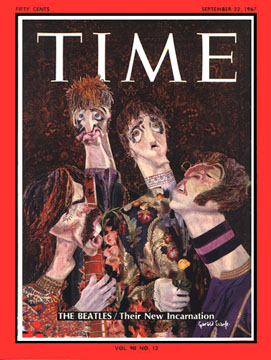
TIME Magazine — First arrivers. Cultural arbiters. Political heralds.

Sellouts.

Really, have you seen the new issue? The "redesign"? It's pathetic. Trying to keep up to speed with today's "short-term-attention-span" culture, the 74-year-old publication has slashed the page count, shortened the features, and enlarged all pictures.

It's as if People got an upgrade. And for some reason decided to write about John McCain or Shiites.

TIME needs to realize that adapting to the culture shouldn't necessitate the product's diluting; especially, that is, if the product is an American touchstone.

Tuesday, February 27, 2007


So apparently some brilliant US senator has proposed a bill that would grant Anne Frank honorary US citizenship. Yes, that Anne Frank.

Now I'm all for honorary US citizenship, and I'm sure Anne Frank more than deserves it. But wouldn't this posthumous gesture be more insulting than honorary? After all, the US barred Anne Frank and her father, Otto, from entering the US in the early 1940s. In fact, during those crucial years, Otto wrote dozens of letters to our consulates pleading for citizenship or at least safe passage.

I hate to say it, but granting Anne Frank US citizenship today would parallel the way in which the Catholic Church handled the whole Joan of Arc affair. Let's not embarrass ourselves in such a way.

Monday, February 19, 2007

Welcome to the Big(otry) Time


New York City is a pretty liberal place. We have sex shops, a surfeit of artists, relaxed liquor laws and an entrenched immigrant population, to boot. So it came as somewhat of a surprise today, after reading a Times article, to learn that gays in Manhattan are still harassed, assaulted, even tormented, for showing the slightest bit of affection in public.

The question left buring in my mind after reading the article was "why?" Why does affection among gay people scare some? Why does it enrage others? Why, moreover, do seemingly normal people feel the need to meddle in strangers’ lives?

And then it hit me — power issues.

We're all, in a sense, born powerless. Besides the literal interpretation of this statement, we as humans don't have much control over many — and some of the most important — facets of our lives.

For instance, cancer could crop up in my liver today, and I could be dead in six months; lightening could just as soon strike a relative dead; a girlfriend could just decide one day to pack up and leave.

Take it or leave it, this is the human condition.

So, with all this in mind, let's return to the question of why people — even to this day, at the height of the information era—still harbor such hostility toward gays.

Simply put, it's an issue — unlike the aforementioned — over which one can exert his control. One does have the power to confront a homosexual couple and say, "Hey, I think what you’re doing is disgusting; life shouldn’t be lived that way."

After all, when we denounce, we pronounce. By upbraiding a gay couple and the way they live, the persecutor is at the same time highlighting what he is not. Doing so gives him a better understanding — or a seemingly better understanding — of who he is, of what he stands for, of his character. The persecutor's yearning to better define himself stems from his not truly understanding the world in which he lives (not even coming close to understanding it).

I guess we can say, then—and pardon me if you find these truths to be self evident—persecuting gays, for some, gives a sense of power, when really we're all powerless, floating 'round and 'round in a universe as vast as ignorance.

Saturday, February 17, 2007

A Step in the Right Direction


Mission Accomplished.

No, not that mission, silly. North Korea. We actually got Kim Jong Il and his cronies this week to call off their nuclear weapons program. If the DPRK makes good on its promise, it will be the first time any country armed with nukes agrees to give them up.

And like any good deal, this one comes with perks. Quoth Time magazine:

"The North is to receive an emergency shipment of 50,000 tons of fuel oil from the U.S., China, Russia and South Korea. The oil is desperately needed to run electric power plants in the impoverished land. If the North permanently disables [another nuclear reactor], the deal calls for another 950,000 tons of oil to be donated."

Granted, President Bush is still far from accomplishing his most prized mission. But he and those folks over at the U.N. (emphasis on those folks over at the U.N.) played their hand nicely against the Dear Leader.

Closing thought: Too bad Iran doesn't need oil.

Sunday, February 04, 2007

Eats, Shoots and BlackBerries


We writers are a picky sort. Hand us any piece of literature—be it a pamphlet, an invitation, even a menu—and the first thing we do, besides read it, of course, is scan the text for errors. We can’t help it.

So it's no surprise, then, that on my subway ride to work, I find myself pondering the ads on the overhang—admiring the cleverness of some, while deriding the grammatical sloppiness of others.

Now, I don't mean to bitch (O.K., maybe I do) but if you're a Madison Avenue copywriter, you're well paid. This means it's your earthbound duty, when writing one or two lines for a product, not to screw up. With that in mind, let's now bring some of the worst offenders to task, shall we?

First up, Research in Motion (RIM). As the maker of BlackBerry, a device catering to top-tier business people, power brokers and intellects alike, you’d think RIM would take the time to edit its copy thoroughly. Here’s the company’s main tagline for the BlackBerry:

“Ask someone why they love their Blackberry.”

Ostensibly, a fine tagline. But if we look more closely, we see that the tagline's first pronoun, "someone," is singular. Therefore, the second pronoun, "they," and the possesive adjective, "their," which both refer to the antecedent, "someone," should be singular. I'm not going to even mention the verb. I will say, however, that were this copy free of errors, it would look like this:

Ask someone why he loves his BlackBerry.

Or, if referring to a corporate shark of the fairer sex:

Ask someone why she loves her BlackBerry.

Moving on.

Perhaps the only thing worse than a company making a grammatical error in its copy, is a company making a logical inaccuracy in its copy—while trying to be cute.

T-Mobile, anyone?

T-Mobile has this little feature on its phones, the “Fav 5.” All it is, really, is a glorified speed dial (albeit one with a dime-size picture of the Fav 5 member whom you're calling). T-Mobile markets this product by posing a question to the ad's viewer, asking him who he'd include in his Fav 5. (Optimally, T-Mobile believes, you'd choose your closest friends.)

“Who knows you secretly cry at chick flicks?,” asks one ad.

Admittedly, that's sort of funny. But we're not here to laugh. So, T-Mobile, listen up and listen well. If someone knows you’re doing something, e.g., crying at a chick flick, it’s NO LONGER A SECRET.

Better would be:

"Who knows you cry, in seceret, at chick flicks?"

All this faulty copy is very unsettling, I know. But the worst isn't over. In fact, just when you think you've suffered all the grammatical and logical errors your heart can handle in one day, you return home on the subway, only to see another flawed T-Mobile ad, for the same product nonetheless.

“Who gets all your inside jokes?”

I'm going to try and make this as simple as possible. This statement is redundant. If you share an inside joke with a friend, of course he "gets" it. Getting an inside joke is an inherent quality of an inside joke.

T-Mobile's idea expressed correctly would be, "Who gets all your weird jokes," or, "With whom do you share inside jokes?"

Advertising: 0
Chad: 1

Tuesday, January 09, 2007

A Farewell to a Farewell to Arms


How would you feel if you walked into your local library one day, asked to check out a book like The Old Man and the Sea or The Iliad, and the librarian told you she no longer “carried” those books? What would you do if, after asking her “Why not?” she said, “Because they just weren’t popular enough”? Such a scenario sound stranger than fiction?

Sadly, it isn’t.

According to a Washington Post article last week, several libraries around the nation are, shall we say, shelving the books that haven’t been checked out for a “long” period of time:
Like Borders and Barnes & Noble, Fairfax [library] is responding aggressively to market preferences, calculating the system's return on its investment by each foot of space on the library shelves—and figuring out which products will generate the biggest buzz. So books that people actually want are easy to find, but many books that no one is reading are gone—even if they are classics.

Now, I know what you’re thinking. The federal government cut funding for libraries, precipitating this "re-prioritizing." Perhaps you’re thinking that scientists found a new pathogen, which resides only in dusty books, and libraries are consequently taking steps to improve their patrons’ health.

O.K., the latter is an obvious no, but more shockingly, the former is too. The libraries are removing authors like Aristotle, Proust and Faulkner because, "We don't want to keep what people don't use much of." Apparently, run-of-the-mill pot-boilers, or novels that have Fabio wearing angel wings on their covers, are considered more interesting.

And while I'm sure the librarians have the best intentions, their actions—even the idea of their actions being acceptable—only underscore the idea that American culture is in decline. We Americans huff and puff about having lots of pride. But how proud can we truly be if it's always about the bottom line?

Sunday, January 07, 2007

Playing Musical Enemies

Here's a letter to the editor I wrote to the Times. I react to an op-ed piece that pretty much argues that the US doesn't know its head from its ass when deciding who its true enemies are, and has only strengthened a new threat (Iran) while eliminating another. Perhaps this is true?

Re "Denying the Facts, Finding the Truth," op-ed, Jan. 5, 2007):


Sadly, Slavoj Zizkek's words ring all too true. As the history of a post-Saddam Iraq continues to unfold, it seems more like all the US did by invading in ’03 was midwife a new era of political rule in which Iran, instead of Saddam's clan, calls the shots.

The irony of this lies in the fact that the US now supports a regime (led by Nuri-alMaliki) whose leaders cater to and are influenced by a perrenial "enemy" of ours.

Tuesday, January 02, 2007

Worth the read

Wow. This piece in today's Times just knocked the wind out of me. Not sure why. Perhaps it was the artfulness. Perhaps the oblique, personal ressonance. Maybe both. Whatever the case, just read and reflect.

Saturday, December 30, 2006


In case you haven't seen that one-minute video of three men in black ski masks leading Saddam Hussein up to the gallows, about to meet his ignominious end, I'll just tell you, although you don't actually see Saddam swing, it’s still gross.

Of course, on many accounts, the hanging was simply a case of a tyrant getting his just deserts. But there's still something deeply disturbing about watching a man, however nefarious, completely at the will of his enemies, his executioners, being primed for death.

And then there's Bush. He really does know how to besmirch the word "democracy." To call Saddam's execution "an important milestone on Iraq's course to becoming a democracy" is an insult. A real milestone would be something that represented peace.

On September 11, 2,997 people were murdered. Nearly 3,000 American troops have been killed in Iraq since the invasion, while over 200,000 Iraqi civilians, too, have perished.

I just don't understand how more death spells cause for celebration.

Sunday, December 17, 2006

Mr.___,in the dining room with the Polonium


A friend with whom I’d often debate international politics once said the Russians could have achieved secure superpower status, like the Americans, had they not always managed to fuck things up.

What he meant to say was the Russians had the brains, but their lack of restraint plus certain, shall we say, mercurial aspects inherent in the Russian temperment would forever hinder their achieving the caliber success commensurate with their talent.

On that score, the recent murder of Alexander Litvinenko by way of the über-deadly, radioactive element Polonium 213 represents another instance in which the Kremlin may have drastically fucked things up.

If Putin in fact had Litvinenko poisoned, he will have, at the same time, seriously damaged Russia's relationship with the West. And how couldn't he have? In one broad stroke, the Kremlin may have utterly flouted every international law, putting countless innocents in mortal danger.

Litvinenko may have been a thorn in Putin’s side—as Anna Politkovskaya definitely was—but the more the Kremlin opts for KGB-style tactics instead of civilized ways with which to deal with dissenters, the further it will estrange itself from the West. After all, who wants to be friends with a country that disregards international law, and on whose home front hired-guns kill anybody challenging the status quo—261 journalists, alone, have been murdered in Russia since ’91.

BUT, ALAS, no charges have been brought against anyone in the Kremlin. If Scotland yard concludes Putin had nothing to do with the murder, then the least Putin can do is help facilitate catching those responsible. But as the matter stands, with British law enforcement barred from conducting a proper investigation on Russian soil, a conviction seems as far away as Russia’s chances of true prosperity.

Sunday, December 10, 2006

With the Iraq Study Group Reporting its findings last Wednesday, President Bush now more than ever seems on the hot seat. And, on many counts, it's a throne he deserves. (In case you haven't heard, the Study Group said Iraq more or less has descended into anus mundi, essentially ringing the death knell for the president’s hopes of transforming a once-totalitarian stronghold into a Jeffersonian-style Democracy.)

Yes, it’s all bad news. But despite this bad news and despite the scandals that have rocked the GOP in the past year or so, Bush & Co. has one saving grace, which way too often goes overlooked:

The United States has not been attacked by terrorists in the almost six years.

Remember after 9/11 there was all that talk of our being attacked again? Hasn’t happened. And, while I disagree with the duplicitous ways in which the Executive Branch has hitherto operated in hopes of augmenting its power, and while I'm disgusted by the human-rights abuses that may or may not have led to a safer America, I have to step back a moment.

I have to step back a moment and say, my other qualms notwithstanding, President Bush at least deserves some credit for the zero attacks since 9/11.