Monday, January 18, 2010

Missed connections


Weird thing I just noticed about Americans or New York culture, rather. It happened when I was walking out into my hallway to throw out my garbage. See, I live in an apartment building, which means if I want to throw out garbage, I have to walk down the hall to the garbage room. Only one such room exists on my floor, and all the people living on 3, whether we like it or not, must make the small trip in our socks from our respective apartment doors to this room, which is equipped with a chute, if we want to dispose of refuse.

Anyway, so there I was in the hall, knotted, black plastic bag in hand, about to start on down the pink carpeting to the trash room, when I look up and see someone else opposite me at the far end of the hallway. I see a woman. She’s an older woman, probably in her 70s, and I thought I’d seen her before — perhaps we’d ridden the elevator together at some point — but, to be honest, I had no idea of her name.

Anyway, so she’s walking toward me, wearing a pink pajama getup — it was 11 p.m. — and I immediately see that she, too, has something in her hand: a garbage bag. Coincidentally, we both walked out into the hallway at the exact same time to take care of this small but necessary chore.

So she's walking toward this garbage room and so am I, albeit from directly opposite directions. Because she's a lot older than I am, and frail, she was walking at a much slower pace. Still, I sped up my gait upon seeing her to rid the air of any confusion that might exist about who will reach, and ultimately use, this room first.

I think I smiled a slight smile right before I opened the door to the garbage room, though I was pretty aware of the fact that she probably didn't make out this expression because she was still probably too far away from me to see it.

Once I finally got my big garbage bag down the chute — sometimes you really have to push — I closed the door and turned to her — she was now significantly closer — and smiled a sort of smile that seemed to say, "Well, here you are, here I am, both throwing out our garbage, meeting in the hallway at 11 p.m. ... Kinda-sorta funny, huh? Well, goodnight."

Yeah, my smile and the way I gesticulated with my head said all that. I know it sounds like a lot, but it did. Anyway, when I smiled at her, I naturally looked into her face for a moment. She really didn't seem to be returning the smile — actually she wasn’t at all — so I quickly looked away.

And so, walking down the long hallway back to my apartment, I started thinking.

Goddamn, I thought. That’s kind of weird. That whole interaction or, rather, non-interaction I just had. I mean, here we are, two people, living in the same apartment building, living feet away from each other, both walking out into the hallway during the last hour of the day, January 17, 20-fu%#ing-10, we see each other, we know each other's motives, we know we're neighbors for Christ's sake, yet we don't say anything to each other. She doesn't even acknowledge me. Strange. Real strange.

And then I thought, what is this phenomenon with Americans? Or shall I say New Yorkers, because, really, to say that this experience I had in the hallway is characteristic of American life is probably flatly inaccurate. But I certainly have noticed this type of behavior in New York.

A few days earlier, in fact, I’d walked into a Barnes and Noble cafe in the city. Every single table at the cafe was taken by a person and there were about 20 tables. However, not one person at this cafe was interacting in any way with the person at the table to his left or right. Each was too absorbed with reading something off his laptop or smart phone. Each was an island to himself. I've noticed this behavior a lot in New York. So close together yet pathetically isolated.

Walking down my long hallway back to my apartment I also couldn't help but think about a positive tradition they have across the Atlantic, in Germany. It goes something like this. Let's say someone — we’ll call him Person A is in a cafe, just sitting there with his coffee and newspaper at a table. Now let's say another person, Person B, a stranger, walks into that same cafe. Person A will most likely greet Person B as he walks in. That's right, odds are that Person A will say “tag” or “morgen,” which means "hello" and "good morning,” respectively. Even more interesting, the person who just walked into the cafe, Person B, the newcomer, might greet everyone in the cafe ¾ or at least those sitting — by saying “hello” out loud. Remember, these people are strangers. Still, these exchanges instantly forge a sense of community or connection.

Furthermore, I recalled that often in Germany when one leaves a room or a cafe or a clothing store, anything, the tradition is to say "bye" as you leave. It’s usually custom to acknowledge the people in the room you’re about to exit. In turn, the other people — the barista, the sales clerk, whoever — acknowledge you and also say, “bye."

To be honest, I could never imagine walking down a hallway to throw out garbage in a German apartment building, seeing a neighbor and not saying "abend" (good evening). It would just be strange.

Now I'm not saying I love Germany or that they've got it all figured out or anything, 'cause god knows Germans have their own issues and peculiarities. But when it comes to these small gestures of acknowledgment, the "Deutsch" are really onto something.

So what's up America? What's up New York? Why are we so standoffish sometimes when it comes to just saying "hi" or "good evening”? Why do we continue to allow ourselves to remain so isolated? Is it because of our high concentration of people? Do we simply take for granted the fact that other souls will always be around us? To the point, perhaps, that we feel we don't necessarily need to say hi to, or even acknowledge, the neighbor who's walking down the same hall at the same time of night, during the same last hour of the day?

If so, that's kind of sad.


Wednesday, January 06, 2010

In Through the Out Door

OK, funny stuff. The other day as I sat at the kitchen table with my girlfriend eating breakfast, I stared — as many do — at the cereal box in front of me. I eat Post Raisin Bran. This time as I stared at the rectangular box, however, I noticed that the Raisin Bran packaging was a bit different from how I'd remembered it. The overall design was a bit prettier. The box's color was a deeper purple and the the Post logo — an oval with the word "Post" inside it — was more bubbly, more three dimensional. In the center of the box there was a big spoon, which displayed the perfect mix of toasted flakes, creamy milk and gleaming raisins. In short, it looked like the Raisin Bran box at some point between the last time I'd eaten the cereal and this time had been redesigned, given a face lift.

After pondering the box and logo a little longer, I turned to my girlfriend who was sitting right next to me and said: "Why do they always have to change things? Why does everything always have to be spiffed up, given a redesign? Can't they just leave the packaging alone. I mean, it's Raisin Brain. Why do they always have to add all these bells and whistles; why do they always have to add new colors and shine?"

Well, my girlfriend — always willing to offer me a counterpoint — turned to me and said: "They have to change the packaging every few years or so. Otherwise, it'll look like the product is old and stale and no one wants to buy a product that looks like it's old or hasn't evolved with the times."

Fair enough, I thought. But I still wondered what this obsession with constantly changing, updating, redesigning was all about.

Anyway, fast forward one week. My girlfriend and I are shopping at the supermarket and we're walking down the cereal aisle. I'm about to pick up my spiffy box of Raisin Bran when I notice something. There's another box that says Raisin Bran right next to it. But the packaging of this other Raisin Bran is completely sober: the box is plain and brown and has no fancy graphics on it. In fact, this other Raisin Brain box looks like it's from a time when people still drove around in massively big cars with massively big steering wheels and public schools came equipped with fallout shelters. The words "Raisin Brain" on the front of of the box were in plain, blocky 2-D letters. This Raisin Bran is also made by Post, I see, but the bubbly Post oval is gone. Instead, the Post name is written in that plain, blocky style as well. 

I rub my eyes. After that, I pick up the cereal and show it to my girlfriend. We both laugh. It turns out, Post recently released some of its cereals in their "vintage packaging." That soberly packaged box of Raisin Brain I saw on the shelf? That's almost exactly what the Raisin Bran box looked like when Post first released the cereal decades ago. No 3-D logos, no golden-brown airbrushed flakes on the front of the box with sparkling raisins and creamy milk, no sidebars telling me about the cereal's health benefits. Just a plain brown, boring box with the words "Raisin Bran" on it. It seems that Post, in a bid to get in touch with its roots or at very least catch the consumer's eye in yet some other way, decided to rerelease this thing and sell it right alongside its modern counterpart.

You gotta love this stuff.

Saturday, December 05, 2009

Over the Top and Falling Short


One thing I love about dating a girl from a foreign country is the fresh perspective she offers.

For example, I know what I think of American culture. I know what I think of the fanfare surrounding Super Bowl ads, the death penalty, Hollywood. But it’s interesting — and sometimes shocking — to hear a foreigner’s take on the same things. It really makes you think.

Enter the discussion my girlfriend and I were having the other day about Lady Gaga.Having been in Germany so long, I had been completely in the dark when it came to the flamboyant, 23-year-old pop princess. But recently, after having returned, I flipped on my TV, saw the music video for Lady Gaga’s new single, “Bad Romance,” and quickly came to understand the fuss.

She struck me as original. The set of the “Bad Romance” video looked like a cross between something out of "2001: A Space Odyssey" and a D&G ad. The hook to the song was cheesy yet irresistible, and Gaga’s dance moves looked one part Michael Jackson’s “Thriller,” one part “Flashdance,” the other something I'd do in front of a mirror if I knew no one were watching.

The point is, Lady Gaga had my attention. I even thought — I'll admit it — she was kind of cool. And so, I decided to tune in to the American Music Award’s last Sunday after having heard she’d be performing.

Now, this performance. You saw it, right?

She comes out on stage in an ecru body suit equipped with antler-like headgear and a breast plate pulsing with lights, sings a song and does a choreographed number with several backup dancers. Then the stage empties save for her. Once alone, she picks up her microphone stand and uses it to smash her way into a huge glass cubicle on stage where a baby grand piano awaits her. (She needs the piano for her next song.) The moment she starts playing — vrum! — the piano’s lip is lit aflame. She then grabs a glass bottle, which had been set up atop the piano, and smashes it down on the keys with one hand while the other still tickles the ivories. She does this several times, with several glass bottles. All in that ecru body stocking.

Now, perhaps I had been in Europe too long. I don’t know. But I found the performance kind of shocking. Although I had liked the Lady Gaga of the “Bad Romance” video — she had struck me as fresh and unafraid — the Lady Gaga of the AMA’s seemed more like someone desperate to make an impression. It didn’t jibe with my prior notions of her.

And so, struggling to understand this discrepancy and looking for someone to offer me fresh perspective, I turned to my girlfriend. I told her about my shock. I told her that it seemed as though Lady Gaga and American entertainment seemed so intense and crazy after having been with her in Europe for so long.

And then my girlfriend said something that gave me pause.

She didn’t mock me for watching a Lady Gaga performance, which I almost certainly thought she would. She didn't mock Lady Gaga. Instead, after I recounted the performance — the fire, the broken glass, the antlers — my girlfriend simply said, “That’s sick.” Just like that, “That’s sick.” Now, she didn’t mean “sick” as in “cool.” She meant “sick” as in “Lady-Gaga’s-performance-is-what’s-wrong-with-your-country sick" — that we've got serious-societal-problems sick. And she meant it.

Normally, after getting such a response from her, I probably would have backpedaled. (I've come to notice I tend to defend the U.S. out of a gut reaction if a non-American is doing the criticizing.) I probably would've said something like, “No…the performance wasn’t really that crazy. I guess we" — as in Americans — "just like to go all out when it comes to entertainment." Perhaps I would have criticized her country, Germany. It’s easy.

But her comment surprised me in a way that forced me to step back. And then I thought — even though it was hard to admit — jeez, this girl might be right. There is a chance that Lady Gaga’s performance and what it represented had moved past the realm of innovative and into "sick."

I wanted to defend Lady Gaga, American music and entertainment, I did. But something just seemed so off with that performance. Gaga seemed so boldly artistic at first. At the AMA’s she seemed more like a bad front yard Christmas display.

Musicians, of course, are known for toeing the line during performances — even leaping right over it. And many have done so successfully. But those performances worked because, often, the artists’ bold moves were cleverly calculated or their antics reflected an emotion felt by the audience at the time or were an expression of the zeitgeist. Lady Gaga, however, just seemed to be going over the top. And falling short.

I kept on thinking about the discrepancy. I had to try and figure out why Lady Gaga seemed to be striking so many false notes with this performance when she did seem to be someone, initially at least, who had talent.

Then finally, it hit me.

Lady Gaga may not be to blame. In fact, her AMA performance probability doesn’t reflect her merit as an artist. She may not be “sick.” What drove her to put on such a performance, however, just might be.

See, the only thing that’s sick — or, let’s be fair, might be sick — is what current pop stars must do to really get noticed. Think about it. Pop culture in America was always a bit of a circus. Now, it’s being transmuted into something crazier, stranger and even more hyperactive.

Why so? I wondered too. It has to do with the age we’re living in, the digital age. The pressures of working as an entertainer in the digital age and the democratization of stardom are reshaping our artists and entertainment. And not necessarily for the better.

Hear me out.

Being talented is no longer enough. Being unique is no longer enough; nor is being on TV. Everyone can be on TV, a.k.a. youtube. The playing field really has been leveled. So what does a pop star like Lady Gaga, who prides herself on individuality as it is, have to do to really get noticed? To really be different? To really shake things up?

She needs to take her performance to the next level. Burn pianos. Wear body stockings. Break glass bottles on keyboards. All to make that impression. If not, she, or any pop star, runs the risk of not being heard, of being drowned out by everyone — literally, everyone — else out there who also wants a piece of the spotlight, and can now actually get it.

And this new landscape may be difficult for an individualistic artist to navigate. Lady Gaga may truly have something special to offer. But because of the pressures associated with working as an entertainer in the digital age, she may be forced to “up her game” a bit and take her performance, her dress, her persona to the next level.

Unfortunately, she might be going too far. When one’s antics start obscuring one’s talents, that’s usually a sign to take a step back. If Lady Gaga doesn't, she runs the risk of simply being labeled silly. And no artist wants that.

Thursday, November 26, 2009

Whole Lotta' Shaking Goin' on


Here's something I scribbled in my Mead notebook a few months ago when I was in Germany. I was sort of bored/in a melancholy mood this particular day, just hanging out in a Starbucks that sat across from a big Gothic cathedral in Aachen, the country's westernmost city. Enjoy.

Aachen, August 16, 2009

Sitting here in Starbucks, not too many people, feeling a bit lonely on a Sunday. I’ve noticed while in Germany that one thing that makes me feel homesick is music, American music. American rock 'n' roll, to be exact. American rock 'n' roll seems to capture, or hold, an innocence, an intensity, an optimistic and fun-loving intensity, which Europe lost with its two World Wars. And forget Germany.

A few minutes ago, one of the baristas here stopped the cafe music that’d been playing. I thought the place was shutting down. But no. She was just switching CD’s. The new CD was a rock 'n' roll one, a “best of” compilation: everyone from James Brown to Elvis to the Temptations. The music got my foot tapping and if anything I was glad the cafe wasn’t closing early. Most stores in Germany don’t even open on Sundays.

Anyway, the music was pleasing enough but then one song came on that really awoke something in me: Jerry Lee Lewis’ 1957 “Great Balls of Fire.” Once I heard the gliss at the beginning, I was “shook” out of my reading. Lewis’ voice was just so full of energy and excitement. The song is a bit horny, actually. All right, it’s overtly horny. But that’s OK; it can be. It can be flirtatious, crazy and a bit boisterous, too — which it is.

And not only did the song shake me out of my reading, it also moved something in me. It transported me for a minute to America. Lewis’ voice made me feel all the excitement, energy and hope that typify the American experience.

No, America is not Europe. Europe may have its museums, its theatre houses, its wine, its architecture and its long history. But America is the land of incredible possibility, of constant change, of dynamism and friction, for good or bad. America is the land of rock 'n' roll.

Sunday, November 01, 2009

German diaries


I don't know how many of you know but I'm in Germany at the moment. Below you can find stuff that I've scribbled down -- obeservations, musings, vignettes -- while here. 

Onelove.

Friday, October 30, 2009

snapshot of Cologne cathedral at sundown


Cologne, August 4, 2009
9:28 p.m.

Sitting on the city-block-long set of steps that leads to a gothic cathedral so big and dirty and hulking and beautiful, it looks like something visited in dreams. The spires of this 900-year-old church rise into the sky. Like sequoias, the Cologne cathedral gives the impression of something that has been here before us and will be here after us. The soot caked on its sharp gothic features testifies to its old age. But still it rises. World War II didn’t even destroy it, so I guess it’ll be around for a while longer. Sitting on a city-block-long set of rough marble steps, hanging out here with about 100 other people. The sound of laughter. The sound of low German, of street German, being spoken. The scratching sound of flint wheels as people light up a smoke. The sun has gone down and the sky is a light blue, a soft-August-twilight blue. In the west, however, the sky holds on to some orange. The sun has sunk past a horizon not visible. Apartments and trees block it. But above these apartments and trees, an orange glow. Sitting on a city-block-long set of steps that leads to the gothic cathedral. Sitting, looking at the Hauptbahnhof. The Hauptbahnof has large illuminated letters on its roof that spell out Hauptbahnhof. Each letter is about the size of a person. The font of the letters is characteristic of another time, before Hitler. There’s something 20’s about the style of the illuminated letters, something Deco, something Weimar. There’s a football-field-size stone plaza in front of the Hauptbahnhof. People are crossing it. Back and forth, back and forth, they go, keeping beat with the metronome of time. Sitting on the city-block-long set of steps that leads to the cathedral.

Cologne, August 4, 2009
9:45 p.m.

Sunday, April 12, 2009

a must-read

Holy crap. If you're interested in a breaking new story chocked with drama, check this out.

Friday, April 10, 2009

The Status Quo

There are many things I don’t understand about America. Our unbridled optimism, our celebrity obsessions, our cross-country networks of fast food chains...Hummers, hero worship, reality TV.

But I can live with those things. What I can’t live with — and perhaps what I least understand about America — is our perennial failure, our abject and shameful failure, to deal with the control of guns.

Week after week, as sure as death itself, some one of our citizens is walking into a public place — be it a church, school or office building — and opening fire on the soft helpless bodies inside.

Just last Friday, a 41-year-old man armed with two pistols entered an immigrant community center in Binghamton, New York, and shot and killed 13 people in an ESL class.

The next day — hell, the next morning! — a man in Pittsburg turned his very own AK-47 on three police officers who showed up to his house to investigate a domestic disturbance call, killing all of them.

And the list goes on: eight senior citizens shot dead in a North Carolina nursing home; a baby killed after another gunman goes on a rampage in Alabama; an Illinois pastor shot to death inside his church.

And that was all in March.

So now here’s my question: What’s it going to take stop these kinds of killings? How many more innocent people — 10, 20 200 — must die before our government passes the kind of legislation that could seriously restrict the ease with which a man can get a gun in this country? Better yet, is it even possible to pass such legislation? Is tighter gun control something we even want? Or is our gun culture too far entrenched to turn back now.

After that nightmarish scene unfolded last Friday in Binghamton, the New York Times asked a man who worked a few doors down from the immigrant center what he made of the shootings, which had, in effect, just transformed his small rural city into a zone of chaos. The man, a pastor, said that, to be honest, he wasn’t all that surprised by what'd just happened considering how frequently such killings occur in America. "It's like our number came up," he said.

How sad it is to live in a country where mass murder has become the status quo.

Friday, November 14, 2008

For Sarah Tea...

OK, interesting stuff. So there's this music Web site called "seeqpod.com," which I'm always on. What is it? Basically, you can enter a song — like, any song by any artist — and seeqpod will call it up and you can listen to the song for free. You can build play lists and everything. The only catch is, you can't burn the songs to CD. It's sorta like youtube but for music. Anyway, what's great about seeqpod is the wide, wide array of music you can call up. What also makes it great is how obscure some of the songs on it are. For example, type in Elliott Smith and you’ll not only get his major songs, but some of his home recordings, studio outtakes and even some amateur recordings taken at his concerts. Stuff you’d never imagine existed.

Anyway, tonight, doing whatever it is I do at my computer, I entered “John Lennon” into the seeqpod search field. I did this because John Lennon is simply the man. Anyway, a list of John Lennon songs appears, and I'm scrolling and I'm scrolling and I see a song called "The Worst Is Over." This intrigues me because, as far as I know, Lennon never recorded a song with this name. Anyway, I play it and, holy shit, I love it from the first note. That's because the "Worst is Over, " I soon realize, happens to be the early-stage recording — probably done at Lennon’s home — of a song that would evolve into a #1 single. It’s a sketch, if you will, of the masterwork, and both are beautiful.

Here it is, “The Worst is Over” or, as it would later be known, “Just Like Starting Over.”


SeeqPod - Playable Search

Wednesday, November 05, 2008

Election Day Story


Hey people. Below you'll find a story I wrote on Election Day last year. I was working for the Daily News that Tuesday, stringing reporting to them about what the flavor was like at a polling place in Queens. Anyway, I took it upon myself to write my own little story while I continued stringing, just jotted it down right there on my pad. The story never got in the paper, so I figured I'd post it here. Have a look, if you'd like.


*

“Excuse me, do you have your registration card?” was what Maria Rodrigo wanted to know as voters walked up to a side door at Public School 82 in Jamaica yesterday anxious to get to the curtained booths inside.

The Queens resident was working for the New York Board of Elections for the day, one of hundreds of similar workers stationed at all the polling places across the city whose job it was to welcome voters — both veterans and first-timers — and help guide them to the polls.

“The job is simple but it’s also hard. We’ll be standing here from 5 a.m. to 9 p.m,” she said.

After that, the work still won't be done. Rodrigo is also part of the team that will count the votes after the polls close, late into the night.

But for now, its’ still just Election Day morning and the people — young, old, black, white, Latino — keep streaming in to vote for their 44th president.

Rodrigo smiled as a man who stood by the school’s doorway offered a blank expression after she asked if he had his registration card.

“It’s okay; people forget them all the time,” she said. “Just sign in at the table and then you can vote.”

On more normal days, Rodrigo, who first came to the United States from Sri Lanka in 1995, works at the Jamaica YMCA. She helps people recently released from prison make the transition to the outside.

“It’s a mighty task, and I only get minimum wage.”

Though she stayed tightlipped when it came to her candidate of choice, higher wages and a break or two for people working in such demanding job are two things Rodrigo would like to see the next president offer.

“It’s a struggle, paycheck to paycheck,” the single mother said. “I’m a taxpayer and I’d like a little more comfort from the government. Not a handout — just a little more comfort. Either way, whoever wins is going to have a lot of mopping up to do.”

A little later, a man who just voted wheels his young daughter out in a stroller. Rodrigo, still standing by the door, still greeting and guiding voters, bent down to get face to face with the little girl.

“Well hello there. Did you get to vote today?

“Yeah,” her father said. “She voted for change.”

Tuesday, August 26, 2008

Wrenching Stuff


Today I worked on a very sad story. A mother and her baby, a baby she never got to see, were buried together. The mother, Donnette Sanz, a New York City traffic agent, was killed a week and a half ago as she crossed a street in the Bronx. She was seven months pregnant. Doctors delivered her baby by emergency cesarean section, and for about a week, the premature infant clung to life. Friday he died. Yesterday was their funeral.

I’ve heard many things from many people while working on this story: “God always takes the good ones,” “The driver of the van should rot in hell,” “This world isn’t fair.” Each comment affects me in its own way. Some I buy into, others I don’t. But let me suspend judgment for a moment to talk about how such tragedies, I think, can be avoided.

With simple responsibility.

If everyone, or at least the majority of people, realized that each action he took has a consequence ranging from from hardly-felt to earth-shattering, this world would be safer and better. It's that simple. It’s also important to realize that there really are no such things as shortcuts. For instance, the driver who slammed into Donnette and caused her death said his "breaks went out." But he had been driving with brake pads so thin, and in such need of repair, that an accident was bound to happen. In other words, this driver chose to take a shortcut: he wanted to drive, but didn't want to meet the basic requirements. This driver might have made thousands of dangerous moves in his life and taken countless shortcuts, and all could have had hardly-felt consequences. But he continued to act negligently, and this time, the consequences were earth-shattering.

The key, then, as we walk away from this tragedy, I guess, is to promise ourselves we won't be negligent with our actions — large or small — when other people's lives are at stake. And that’s friend or stranger.

Tuesday, April 17, 2007

We've Seen Better Days


America is sick.

Wait, let me take that back. Sick may not be the right
word.

Ailed.

Thirty-two dead on Virginia Tech's campus. Over three thousand soldiers killed in Iraq. A culture that perpetuates, facilitates and glorifies violence.

And we wonder why?

I know—I should probably slow down. After all, you can't blame all American culture for one 23-year-old's psychopathy. And, at first glance, the massacring of VT students seems unrelated to our government's hasty call for war, which has led to a staggering number of GI deaths. But both instances have an important point in common: the ideas for both were hatched on our turf.

And while in the end, violence of course knows no borders, what time would be better than now to ask, is the US serving as a more efficient incubator for violence?

Let’s skip to the part where I answer that: Yes.

Look at our movies, our music, our video games, even our sports. Violence is manifest in each of these categories. Granted, most of us can tell the difference between fictional violence and real-life consequences, and would therefore never let entertainment drive us to such madness. But even the most impervious among us surely have, at some point, been critically influenced by entertainment and fantasy. So what effect is suggestive entertainment having on people with serious mental conditions? Is it not spurring them on?

It must be. If life seems disposable in the entertainment world, some may think it truly is. And while the VT killer was exceptionally psychopathic, he lived in a society that accepts violence as an answer to many questions; he lived in a country in which guns are readily available, and in a state, pronouncedly so, that considers those guns a birth right. He lived in a culture in which characters like Tony Soprano are looked up to and preened on magazine covers; in which many teenagers pass their time playing games like “Grand Theft Auto.” He lived in a country that considers two men pummeling each other’s faces sport.

How could living in such a society not have influenced him? And, if these aspects did, why are we debating campus safety? Shouldn’t we instead be reevaluating the more troubling aspects of American culture?

Now I know I’m not the first to bring up these issues. Turn on any news talk show in the mid/late ’90s—the Columbine era, if you will—and the talking heads would be debating similar, if not identical, issues. At the heart of those many debates, as I’m sure you know, was that famous question: Should we, whenever the opportunity arises, excise—or at least highly limit—violence’s manifestations in our art and culture?

My answer to that? No.

Doing so curtails freedom of speech. And censorship (as history can attest) only leads to other forms of problems, not to mention twisted psyches. Better in this case is to ask, why this fascination with violence? After all, no one is forced to view an inanely violent film or bop his head to hateful lyrics. We chose these pursuits. Asking "why," and exploring what's behind these issues may be tantamount to taking the first steps toward remedy. Here are three brief possibilities.

•Violent entertainment and the culture of it serve as a foil to our tirelessly-pursued “ideal” American lives. Perhaps America is so obsessed with and elated by money, leisure activities, gourmet food, vacation homes, fast cars, etc. that we yearn for something more sinister to balance out "the good life." If we didn’t maniacally insulate ourselves against many of the world’s woes, moreover, we’d better see what life was really like, how grim much of it is. In turn, the darker aspects of existence would fascinate us less.

•Interestingly—and ironically enough—Americans may be more prone to violence because we may be obsessed with protecting this aforementioned way of life. We love our possessions; ditto for our social mobility. But do we love our roaring-on-all-engines type capitalism with equal intensity? If so, are we willing to die for it and the luxuries it affords? Further still, do we believe that the path to righteousness for every country is only attained by mirroring us, as in U.S.?

•Like it or not, the bible and its principles heavily inform and shape American culture. One well-known principle regarding revenge/justice, “an eye for an eye, a tooth for a tooth,” may lie at the heart of many of our violence-issues. Simply put, this saw, which of course originated in the bible, is something that we collectively believe in. Remember when Bush repeatedly said after 9/11 that the US would "hunt down and kill the terrorists"? Remember how much of America agreed? Agreed to "hunt" and "kill"? Were the bible not to influence our country so, perhaps violence—pertaining to retribution or not—would be less acceptable.

Now, I said at this essay’s beginning America was ailed. Although I just listed a few reasons for this sickness, my examples, for what they’re worth, don’t necessarily mean that the sickness is fatal. America, moreover, is not rotten. There are some great ideals buried beneath the bad. But America may never become—or at least may never move closer to becoming the ideal country we purport to be—if we continue to fail to see our obsession with and condoning of violence is actually harming us.


II

All said, it’s time to explore another issue, which is in the same vein. It, too, involves how entertainment shapes our consciences, similar to much of what I talked about in this essay's first half. But it involves what we don’t see. It’s subtle. And that’s what makes it scary.

So what am I talking about? Glad you asked.

OK, think entertainment.... Now think censorship. The American government allows us to watch as much violent entertainment as we please; it’s unfettered. But let that gore spill over into the real-life sector, and it's suddenly off limits. Think about it. We don’t see dead American troops on the nightly news. We don’t see dead Iraqi children, “collateral damage,” on magazine covers. Paradoxically, the things—the images and sounds—we don’t see shape our psyches and imaginations just as much as what we do.

How so? Well, here's where the negative effect of violent entertainment again rears its ugly head. When we read or hear about war, about dead American troops, about "collateral damage," our minds, in the need to process it all, revert to what they know about such situations—i.e., all that has been gleaned from images in movies and on TV. Naturally, we supplant images and ideas. Because of this supplanting, when we read or hear about true-life violence, we may be able to reconcile it better. This is why we may think death is quick; this is why we think it can be honorable.

Would it not be fair to say, then, that America imbibes in the type of violent entertainment it does because it's too scared to ask itself some real questions or see some real pictures or listen to some real sounds, namely the voice of the dying?

Is America content escpaing to fantasy land—as has often been the case—where ketchup is used as blood, instead of asking itself where it truly stands on violence? Is America content to run to the movies when it should be incessantly asking itself about how it feels having started a war in a Middle-Eastern country? About being responsible for civilian deaths in Iraq—because civilians have died by our hand, meaningfully or not.

I ask you: What if our government showed us what the true face of the Iraq war looked like? What would the national mood be then? I’m talking dead American troops; I’m talking disemboweled and beheaded Iraqi civilians. Pictures, movies, lots of them. If we saw these images on the nightly news would we still be in Iraq? Or, more pointedly, if we had always been granted full access to the images of war's effects, would we go with the frequency we do?

And what about Virginia Tech? If we actually saw what those hollow-point bullets did to a nineteen-year-old’s face. If we got actually to see the fragments of that Holocaust survivor’s brain, splattered like oatmeal on the walls, would the NRA still have the clout it does? Further, would the public still stand by the NRA as it gives the same, tired rebuttals when such tragedies occur? Would Americans still be as passionate about the right to bear arms?

Or, America—yeah you!—do we want to continue to live in a fantasy world imagining what such guns do, imagining how violence looks or feels?

I'm not a voyeur, but if we, as in Americans, are so enamored by and accepting of violence, let's stop for a moment and take a true look at it, in every manifestation.

I promise you, you'd hate what you'd see.

Saturday, April 14, 2007

Imust Comment

Since everyone and their mother are weighing into the whole Imus thing, I figured, why not. Here's something I wrote on a NY Times blog.

Two things. First, it's incredibly hard, perhaps impossible, to understand how much it hurts to have an epithet hurled at you if you’re not a part of the ethnic/racial group on its receiving end. It’s not fair to say, then, that Imus’s remarks didn’t warrant his firing. Maybe they did. I’m not black; I can’t tell you how deep that well of pain goes.

Second, and somewhat separately, America has lost all control. Our troops are getting killed in Iraq every day, but that's not what's on the front page every day. We’re not obsessed with the Iraq war; we should be.

Until we figure out how to improve — nay, master — the security conditions for our troops and draw up a devastatingly accurate way forward in that country, issues such as those mentioned in my first paragraph deserve less attention. Sticks and stones first. Then names.

Friday, March 30, 2007

Of Olympic Rings, Deadly Dealings


Here's a letter I wrote to the Wall Street Journal. It's about China's shady business dealings with Sudan, home of the Darfur genocide. The authors beg us to reconsider the 2008 Olympics, which will be held in Beijing, now that we have the knowledge that China, albeit in a roundabout way, is supporting genocide:

Mr. and Ms. Farrow raise some hard-to-escape truths about the dark side of Chinese politics and the coming Olympic Games("The Genocide Olympics," Op-Ed, March28). Beijing’s intransigence on Darfur has indeed been debilitating. And, as the Farrows argue, a country that facilitates genocide — however obliquely — should be reprimanded, not feted.

Shockingly enough, China’s faults in this case don’t end with irresponsible business deals with Sudan and a shameful U.N. record on Darfur. Some speculate that the Chinese intend to ease censorship laws for the Games. This policy is flat backward. The Olympics shouldn’t be the spur for freer speech in China — especially, that is, if Beijing intends to rescind those policies soon after. (Wasn’t it the Nazis, after all, who briefly dissolved all signs of overt anti-Semitism at the ’36 Games to give the pretense of a more peaceful society?)

And, while saying, as the Farrows do, that Mr.Spielberg’s participation in the ’08 Olympics could somehow be akin to what Leni Riefenstahl did in ’36 might be shocking, it’s not completely unfounded. Mr. Spielberg — as well as the multinational corporate sponsors now armed with this knowledge — need to take a fresh look at how they will deal with the problem. After all, this isn’t a small conflict of interest. This is genocide.

Saturday, March 17, 2007


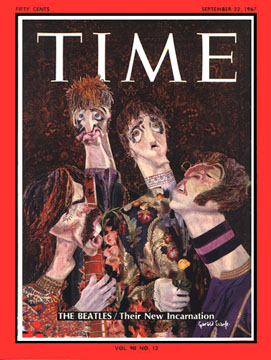
TIME Magazine — First arrivers. Cultural arbiters. Political heralds.

Sellouts.

Really, have you seen the new issue? The "redesign"? It's pathetic. Trying to keep up to speed with today's "short-term-attention-span" culture, the 74-year-old publication has slashed the page count, shortened the features, and enlarged all pictures.

It's as if People got an upgrade. And for some reason decided to write about John McCain or Shiites.

TIME needs to realize that adapting to the culture shouldn't necessitate the product's diluting; especially, that is, if the product is an American touchstone.

Tuesday, February 27, 2007


So apparently some brilliant US senator has proposed a bill that would grant Anne Frank honorary US citizenship. Yes, that Anne Frank.

Now I'm all for honorary US citizenship, and I'm sure Anne Frank more than deserves it. But wouldn't this posthumous gesture be more insulting than honorary? After all, the US barred Anne Frank and her father, Otto, from entering the US in the early 1940s. In fact, during those crucial years, Otto wrote dozens of letters to our consulates pleading for citizenship or at least safe passage.

I hate to say it, but granting Anne Frank US citizenship today would parallel the way in which the Catholic Church handled the whole Joan of Arc affair. Let's not embarrass ourselves in such a way.

Monday, February 19, 2007

Welcome to the Big(otry) Time


New York City is a pretty liberal place. We have sex shops, a surfeit of artists, relaxed liquor laws and an entrenched immigrant population, to boot. So it came as somewhat of a surprise today, after reading a Times article, to learn that gays in Manhattan are still harassed, assaulted, even tormented, for showing the slightest bit of affection in public.

The question left buring in my mind after reading the article was "why?" Why does affection among gay people scare some? Why does it enrage others? Why, moreover, do seemingly normal people feel the need to meddle in strangers’ lives?

And then it hit me — power issues.

We're all, in a sense, born powerless. Besides the literal interpretation of this statement, we as humans don't have much control over many — and some of the most important — facets of our lives.

For instance, cancer could crop up in my liver today, and I could be dead in six months; lightening could just as soon strike a relative dead; a girlfriend could just decide one day to pack up and leave.

Take it or leave it, this is the human condition.

So, with all this in mind, let's return to the question of why people — even to this day, at the height of the information era—still harbor such hostility toward gays.

Simply put, it's an issue — unlike the aforementioned — over which one can exert his control. One does have the power to confront a homosexual couple and say, "Hey, I think what you’re doing is disgusting; life shouldn’t be lived that way."

After all, when we denounce, we pronounce. By upbraiding a gay couple and the way they live, the persecutor is at the same time highlighting what he is not. Doing so gives him a better understanding — or a seemingly better understanding — of who he is, of what he stands for, of his character. The persecutor's yearning to better define himself stems from his not truly understanding the world in which he lives (not even coming close to understanding it).

I guess we can say, then—and pardon me if you find these truths to be self evident—persecuting gays, for some, gives a sense of power, when really we're all powerless, floating 'round and 'round in a universe as vast as ignorance.

Saturday, February 17, 2007

A Step in the Right Direction


Mission Accomplished.

No, not that mission, silly. North Korea. We actually got Kim Jong Il and his cronies this week to call off their nuclear weapons program. If the DPRK makes good on its promise, it will be the first time any country armed with nukes agrees to give them up.

And like any good deal, this one comes with perks. Quoth Time magazine:

"The North is to receive an emergency shipment of 50,000 tons of fuel oil from the U.S., China, Russia and South Korea. The oil is desperately needed to run electric power plants in the impoverished land. If the North permanently disables [another nuclear reactor], the deal calls for another 950,000 tons of oil to be donated."

Granted, President Bush is still far from accomplishing his most prized mission. But he and those folks over at the U.N. (emphasis on those folks over at the U.N.) played their hand nicely against the Dear Leader.

Closing thought: Too bad Iran doesn't need oil.

Sunday, February 04, 2007

Eats, Shoots and BlackBerries


We writers are a picky sort. Hand us any piece of literature—be it a pamphlet, an invitation, even a menu—and the first thing we do, besides read it, of course, is scan the text for errors. We can’t help it.

So it's no surprise, then, that on my subway ride to work, I find myself pondering the ads on the overhang—admiring the cleverness of some, while deriding the grammatical sloppiness of others.

Now, I don't mean to bitch (O.K., maybe I do) but if you're a Madison Avenue copywriter, you're well paid. This means it's your earthbound duty, when writing one or two lines for a product, not to screw up. With that in mind, let's now bring some of the worst offenders to task, shall we?

First up, Research in Motion (RIM). As the maker of BlackBerry, a device catering to top-tier business people, power brokers and intellects alike, you’d think RIM would take the time to edit its copy thoroughly. Here’s the company’s main tagline for the BlackBerry:

“Ask someone why they love their Blackberry.”

Ostensibly, a fine tagline. But if we look more closely, we see that the tagline's first pronoun, "someone," is singular. Therefore, the second pronoun, "they," and the possesive adjective, "their," which both refer to the antecedent, "someone," should be singular. I'm not going to even mention the verb. I will say, however, that were this copy free of errors, it would look like this:

Ask someone why he loves his BlackBerry.

Or, if referring to a corporate shark of the fairer sex:

Ask someone why she loves her BlackBerry.

Moving on.

Perhaps the only thing worse than a company making a grammatical error in its copy, is a company making a logical inaccuracy in its copy—while trying to be cute.

T-Mobile, anyone?

T-Mobile has this little feature on its phones, the “Fav 5.” All it is, really, is a glorified speed dial (albeit one with a dime-size picture of the Fav 5 member whom you're calling). T-Mobile markets this product by posing a question to the ad's viewer, asking him who he'd include in his Fav 5. (Optimally, T-Mobile believes, you'd choose your closest friends.)

“Who knows you secretly cry at chick flicks?,” asks one ad.

Admittedly, that's sort of funny. But we're not here to laugh. So, T-Mobile, listen up and listen well. If someone knows you’re doing something, e.g., crying at a chick flick, it’s NO LONGER A SECRET.

Better would be:

"Who knows you cry, in seceret, at chick flicks?"

All this faulty copy is very unsettling, I know. But the worst isn't over. In fact, just when you think you've suffered all the grammatical and logical errors your heart can handle in one day, you return home on the subway, only to see another flawed T-Mobile ad, for the same product nonetheless.

“Who gets all your inside jokes?”

I'm going to try and make this as simple as possible. This statement is redundant. If you share an inside joke with a friend, of course he "gets" it. Getting an inside joke is an inherent quality of an inside joke.

T-Mobile's idea expressed correctly would be, "Who gets all your weird jokes," or, "With whom do you share inside jokes?"

Advertising: 0
Chad: 1

Tuesday, January 09, 2007

A Farewell to a Farewell to Arms


How would you feel if you walked into your local library one day, asked to check out a book like The Old Man and the Sea or The Iliad, and the librarian told you she no longer “carried” those books? What would you do if, after asking her “Why not?” she said, “Because they just weren’t popular enough”? Such a scenario sound stranger than fiction?

Sadly, it isn’t.

According to a Washington Post article last week, several libraries around the nation are, shall we say, shelving the books that haven’t been checked out for a “long” period of time:
Like Borders and Barnes & Noble, Fairfax [library] is responding aggressively to market preferences, calculating the system's return on its investment by each foot of space on the library shelves—and figuring out which products will generate the biggest buzz. So books that people actually want are easy to find, but many books that no one is reading are gone—even if they are classics.

Now, I know what you’re thinking. The federal government cut funding for libraries, precipitating this "re-prioritizing." Perhaps you’re thinking that scientists found a new pathogen, which resides only in dusty books, and libraries are consequently taking steps to improve their patrons’ health.

O.K., the latter is an obvious no, but more shockingly, the former is too. The libraries are removing authors like Aristotle, Proust and Faulkner because, "We don't want to keep what people don't use much of." Apparently, run-of-the-mill pot-boilers, or novels that have Fabio wearing angel wings on their covers, are considered more interesting.

And while I'm sure the librarians have the best intentions, their actions—even the idea of their actions being acceptable—only underscore the idea that American culture is in decline. We Americans huff and puff about having lots of pride. But how proud can we truly be if it's always about the bottom line?

Sunday, January 07, 2007

Playing Musical Enemies

Here's a letter to the editor I wrote to the Times. I react to an op-ed piece that pretty much argues that the US doesn't know its head from its ass when deciding who its true enemies are, and has only strengthened a new threat (Iran) while eliminating another. Perhaps this is true?

Re "Denying the Facts, Finding the Truth," op-ed, Jan. 5, 2007):


Sadly, Slavoj Zizkek's words ring all too true. As the history of a post-Saddam Iraq continues to unfold, it seems more like all the US did by invading in ’03 was midwife a new era of political rule in which Iran, instead of Saddam's clan, calls the shots.

The irony of this lies in the fact that the US now supports a regime (led by Nuri-alMaliki) whose leaders cater to and are influenced by a perrenial "enemy" of ours.

Tuesday, January 02, 2007

Worth the read

Wow. This piece in today's Times just knocked the wind out of me. Not sure why. Perhaps it was the artfulness. Perhaps the oblique, personal ressonance. Maybe both. Whatever the case, just read and reflect.

Saturday, December 30, 2006


In case you haven't seen that one-minute video of three men in black ski masks leading Saddam Hussein up to the gallows, about to meet his ignominious end, I'll just tell you, although you don't actually see Saddam swing, it’s still gross.

Of course, on many accounts, the hanging was simply a case of a tyrant getting his just deserts. But there's still something deeply disturbing about watching a man, however nefarious, completely at the will of his enemies, his executioners, being primed for death.

And then there's Bush. He really does know how to besmirch the word "democracy." To call Saddam's execution "an important milestone on Iraq's course to becoming a democracy" is an insult. A real milestone would be something that represented peace.

On September 11, 2,997 people were murdered. Nearly 3,000 American troops have been killed in Iraq since the invasion, while over 200,000 Iraqi civilians, too, have perished.

I just don't understand how more death spells cause for celebration.

Sunday, December 17, 2006

Mr.___,in the dining room with the Polonium


A friend with whom I’d often debate international politics once said the Russians could have achieved secure superpower status, like the Americans, had they not always managed to fuck things up.

What he meant to say was the Russians had the brains, but their lack of restraint plus certain, shall we say, mercurial aspects inherent in the Russian temperment would forever hinder their achieving the caliber success commensurate with their talent.

On that score, the recent murder of Alexander Litvinenko by way of the über-deadly, radioactive element Polonium 213 represents another instance in which the Kremlin may have drastically fucked things up.

If Putin in fact had Litvinenko poisoned, he will have, at the same time, seriously damaged Russia's relationship with the West. And how couldn't he have? In one broad stroke, the Kremlin may have utterly flouted every international law, putting countless innocents in mortal danger.

Litvinenko may have been a thorn in Putin’s side—as Anna Politkovskaya definitely was—but the more the Kremlin opts for KGB-style tactics instead of civilized ways with which to deal with dissenters, the further it will estrange itself from the West. After all, who wants to be friends with a country that disregards international law, and on whose home front hired-guns kill anybody challenging the status quo—261 journalists, alone, have been murdered in Russia since ’91.

BUT, ALAS, no charges have been brought against anyone in the Kremlin. If Scotland yard concludes Putin had nothing to do with the murder, then the least Putin can do is help facilitate catching those responsible. But as the matter stands, with British law enforcement barred from conducting a proper investigation on Russian soil, a conviction seems as far away as Russia’s chances of true prosperity.

Sunday, December 10, 2006

With the Iraq Study Group Reporting its findings last Wednesday, President Bush now more than ever seems on the hot seat. And, on many counts, it's a throne he deserves. (In case you haven't heard, the Study Group said Iraq more or less has descended into anus mundi, essentially ringing the death knell for the president’s hopes of transforming a once-totalitarian stronghold into a Jeffersonian-style Democracy.)

Yes, it’s all bad news. But despite this bad news and despite the scandals that have rocked the GOP in the past year or so, Bush & Co. has one saving grace, which way too often goes overlooked:

The United States has not been attacked by terrorists in the almost six years.

Remember after 9/11 there was all that talk of our being attacked again? Hasn’t happened. And, while I disagree with the duplicitous ways in which the Executive Branch has hitherto operated in hopes of augmenting its power, and while I'm disgusted by the human-rights abuses that may or may not have led to a safer America, I have to step back a moment.

I have to step back a moment and say, my other qualms notwithstanding, President Bush at least deserves some credit for the zero attacks since 9/11.

Making It to the Next Round


Every now and again, between wondering what to eat for dinner or which iTunes songs to download, we stop to ponder the origin of our existence. Some frequent high-vaulted cathedrals for the answers, others meditate in their living rooms. Whatever the case may be, there is no disputing that the existing points of view are myriad. (Bear with me, it's worth it.)

Despite all these ideas, one popular explanation for the origin of humankind goes something like this: An omniscient, omnipotent and ubiquitous God put us on Earth, for better or worse. People who subscribe to this idea may also believe that proof—yes, proof—of this God’s existence is evinced in each of us, in the form of a good, just and wholesome soul.

Furthermore, some people may think that if they act properly, have a strong sense of morality and respect their county's justice system or rule of law, they are doing so because God’s grace resides in them, propelling them toward the “right” path.

Now, while I’m not too much of a God person, I may have even believed something similar at one point. With that in mind, think about how I felt after reading the following quote, from an essay written by E.O. Wilson and Michael Ruse, a biologist and a philosopher, respectively, about ethics, God and society.

"Ethics is an illusion fobbed off on us by our genes to get us to cooperate, and the way our biology enforces its ends is by making us think that there is an objective higher code to which we are all subject."
Astounding.

According to this theory, which is enough to make a true believer keel over in disgust, our genes (like, our DNA) trick us into believing that a higher power, namely God, wants us to abide by society’s ethical codes and fear “The Wrath.” For if we act uprightly, if we constantly believe God is watching all our actions, our decisions will be more constrained—more rational—which will result in our leading safer, and perhaps healthier, lives. That, in turn, will increase our overall chances of propagating.

It takes a while to sink in, I know. And,after all, who know's at all if it's true. But what an interesting way to look at some questions none of us can truly answer.

Friday, November 24, 2006


I think it's about time.

After three years of unabated bloodshed in Iraq, the idea of now leaving the place to the dogs, if such an expression is even suitable, no longer sounds so bad. Although I've longed believed the invasion to be almost completely unjustifiable and, like everyone else, ill planed, I at least took solace in the idea that America, at very least, was helping the Shia, a once marginalized, if not persecuted, people. Well, things have changed. Through the Mahadi Army, many Shia have proven that they can be just as brutal. By no means, then, is it in America's interest to mediate a war between two religious sects hell-bent on each other's demise.

I think it's about time.

Tuesday, November 21, 2006

E.S.


"Playing things too safe is a popular way to fail. Dying is another."

Why is that when raw talent and tragedy collide, a seductive story is almost always born? Think about it—Jim Morrison, Kurt Cobain. The list is long. But somewhere wedged between Jimmy Hendricks and Jeff Buckley is Elliott Smith (who’s incidentally quoted above). For those who don’t know, Smith was a singer/songwriter who came into the national spotlight after composing most of the songs on the "Good Will Hunting" soundtrack in 1997.

Now I'm not going to lie, when it comes to Elliott Smith, I'm a little late to the party. (When he died in ’03, I only vaguely knew of him.) But I don't care. This is music that deserves an audience. Many of his melodies are Beatlesquely tinged and his lyrics are visceral. Hell, in each song Smith swims to the bottom of his emotional pool, grabs something lying on its floor and then returns to the surface with it, for all of us to see. His lyrics wind up reading like this:

"It’s 2:45 in the morning, and I’m putting myself on warning.” Or, "I'm burning every bridge that I've crossed to find a beautiful place to get lost."

Aren't those heartbreakingly elegant? Again, I won’t lie—knowing that Smith killed himself colors my take on these lyrics. They’re of course freighted with doom. But, in some strange way, isn’t that what makes them great? Isn’t that why we like these dead rock stars, or why tragedy allures us? It reminds us how delicate and ephemeral life is. How blessed—and sometimes tortured—we all are. What could be more seductive?

Here’s a Smith line that’s played on repeat in my mind for the past week or so. Enjoy.

"Nobody broke your heart/you broke your own, ’cause you can’t finish what you start.”

Sunday, November 19, 2006

A Hard-to-Define Absence


It’s funny. Proud as I may be of my native-New Yorker status, and proud as I am to have a deep knowledge of the city, I feel no more of a kinship to the Ground Zero site than, say, a tourist from New Zealand. Though I pass Ground Zero on my way to work each day, and have perfect view of it from my office’s window, I feel nothing but a sad astonishment (which is probably what any true American feels when he or she thinks to that day). The only way to have a real kinship with the site, I believe, is to have been directly affected by Sept. 11. Did you get soot on your face? Did your loved one never make it home? Did your life’s work vanish in seconds? If the answer is yes to any of the above, then you can claim the site as yours, for better or probably worse. I was safe at college that morning and feel almost dirty when pondering how the absence of the Towers makes me feel, even as a New Yorker

The bigger question: do any of us ever have the right to comment on anything in which we've played no part or on pain we've never felt?

Wednesday, October 04, 2006

A Lost Art Form Redivivus

Few objects have the transportable power of a book whose title is A Treasury of the World’s Greatest Letters.

Published in 1941, this book, which I rescued from my college library’s “discard” bin, examines the personal correspondences of exceptional people in history, everyone from Mozart to Chekhov to Otto von Bismarck.

Though I only open it occasionally, each time I do, the diligence and grace with which the authors wrote always precipitates a feeling of lament in me. Is such a craft even compatible with our modern world, I wonder?

All right, I don’t lament too long.

At any rate, listed below is an excerpt from one of these letters. Though almost every letter in this book is penned by one of history’s boldface names, the last one is written by a much lesser known man.

His name was Stanley Lupino, a British actor and director living in his native London, and he was serving as an Air Raid warden during the Battle of Britain. In between the sirens and blackouts, he wrote a letter to his wife and daughter in America about the courage and ingenuity of the British people during that epic battle in 1940, when the Luftwaffe bombing campaigns were as expected and constant as the gloomy weather.

They don’t laugh at wardens anymore. They bless us and look upon us as their greatest friends in need. Children run to us when they see the familiar black tin hat with the ‘W’ on it in white. Conductors won’t take fares from us and shops hardly want to take payment when we walk in. We are policemen, nurses, firefighters, watchers for danger, aids in sickness, and [givers of] comfort and confidence to all and sundry….

During the night I visit the sleeping people in [air-raid] shelters. I never speak, only stand and inspect them, but they all say they feel my presence even in darkness….They know the familiar sound of my walk and the soft read of my heavy gum boots. I never wake them…. If one wants to talk they whisper. One girl, a typist in the City, was awake in a shelter for 60 [people], but had 140 in it, huddled in heaps on the floor. She looked up and whispered, ‘Hold my hand, sir, just for a minute.’ I said, ‘Of course.’ After a while she pressed it to her face, and said, ‘I feel better now. I haven’t seen my husband for three months and I’m going to have a baby. I just wanted to feel a man’s hand against my face….’

This is only a few of the things that happen, choky, heart hurting things that make you have to brace up and bite your lip. It’s not the bombs, or the guns, that upset you; it’s the lovableness of the people. Their hearts and souls laid bare—and when laid bare, it’s so sweet to see.

Hope you enjoyed it.

Wednesday, September 27, 2006

The list goes on and on....


Anyone who reads the New York Times each day knows how exhaustingly sad an experience it can be. “Dining Out” and “Escapes” sections notwithstanding, most of the paper—especially, the “International” section—is filled with images of violence and misery. Unfortunately, such content eventually become so repetitive, so expected, the reader builds a tolerance to it.

A few years ago, after noticing my tolerance to these sad images and stories growing, and not wanting this tolerance to mutate into apathy, I made myself a promise: Until the war's end, I’d read the list of names of American soldiers recently killed in combat, a list the Times publishes every day, which also contains the age, hometown, ranking and battalion of each soldier lost.

Although this list doesn’t even come close to representing the breadth of the war’s casualties, especially on the Iraqi side, still, it was some sort of reminder.

This is what I'd read:

Doe, John A., 19, Sgt.,
Buffalo, NY.; 40th
Engineer Battalion,
Second Brigade Combat
Team, First Armored Div.

Reading this information, word for word, hometown for hometown, I believed, would make the war seem somewhat “real.” Reading this info would remind me, at least for the moment, that the Iraq war isn't just of captioned photos and tightly written stories. These were real men and woman. These were real teenagers.

So what’s my whole point for this post? It’s quite simple: I recently stopped reading the names.

It’s not that I didn’t care any more, I did. But after a while the constant stream of death tired and sickened me.

Now I don’t serve as any sort of bellwether for America’s overall opinion or the way toward which we’re moving as a country on Iraq, but if I, a person who for two years actually ruminated over the fate of these dead soldiers (however minute an act it is), recently stopped bothering to read these names, If I’ve grown slightly apathetic and uninterested, what does that say about much of America, who, I believe, at least, may have never really cared about many of the issues in the first place?

What does that say about our future as a country? Is this the new status quo? Is America comfortable with being a country that entangles itself in foreign conflicts, and whose soldiers die in droves, while many on the home front simply ignore the daily deaths? Are we becoming a country that is comfortable with the fact that, so many of our soldiers have died, the New York Times is able to print a fresh list of dead soldiers' names each day. Each day!

America needs to realize that the halcyon days are over.

Not only are the halcyon days over, but it's time for some serious attitude adjustments. Instead of watching game shows like “Deal or no Deal?," in which money is profligately tossed about, instead of worrying about how we can buy into that luxury condo in Manhattan, or quibbling over a few cents’ increase in the gas price, we should all, collectively, be thinking of how we are going to prevent another of our soldiers from making that damn list.

Sunday, September 24, 2006

Hating the Palliating

Talk about at a lesson in euphemistic language.

Jeep, the car company owned by GM, just had a commercial on TV advertising its fall deals. Fine. But at the end of the commerical, Jeep reminds customers to partake in the company’s letter writing campaign to "our overseas troops."

Fucking overseas? Give me a break. According to the A.P., the number of American troops killed in Iraq just surpassed the amount of people killed in New York on 9/11.
These troops are more than people who are overseas. My friend Stuey, who's backpacking through Europe and trying to find himself, is "overseas."

What's wrong? using the word Iraq or soldiers or military or figthers isn't palatable? Well not much in war is.

With all the ways to describe USA's might, it's interesting to note that on the home front, and in happy little car commercials, we say "overseas troops."

Any American soldier in Iraq is fighting for his or her life. It's a macabre ordeal fought with weapons that look like something out of H.R. Giger's imagination.

But, then again, do we Americans really care?

The war is so far away, so remote. And that new Jeep Cherokee comes with all leather interior and dual-zone climate control.

Tuesday, September 19, 2006

Can't Outrun Your Shadow


Here's an essay I wrote for a class a while back. Thought it was interesting enough to post, but I don't necessarily agree with everything I wrote. Nevertheless, it felt right at the time. Agree with it or disagree, if you'd like.

Time and again many great thinkers have proclaimed mankind a peaceful animal, albeit one driven to violence by iniquity. Were man granted an equal share of territory and equal access to resources, these thinkers argued, his soul would be fulfilled, obviating the need to perpetrate crimes or, for that matter, make war. And sadly, time and again, man, through his actions, has proved this notion wrong. History has shown us that even when a man seemed content—i.e., had a surfeit of land, a full belly and a heavy coin purse—he still wanted more. Suffice to say, then, that war, crime or enmity doesn’t stem from a dearth of land or resources but instead from an intrinsic flaw in mankind’s nature.

What happened in Nazi Germany underpins this theory. When Adolf Hitler came to power in 1933, he instituted radical economic polices, many of which were incredibly successful, over a Germany that had, through the Weimar era, been destitute. By the time war WWII began, Hitler didn’t need any more land or resources for his people. The Reichsmark had recovered nicely, and Germans were again eating well. Germany’s problems, in fact, had never really centered on lack of land.

However, one of many impetuses for Hitler’s war was land acquisition. But the Führer didn’t want to harvest crops: he wanted more land with which he could better nourish German children, his cannon fodder. What is more, Hitler wanted to expand the Reich, so it could be harder to defeat—thanks to more resources and manpower—on the battlefield. Here is the perfect case of a man, who did not need more land, a man whose human condition was relatively agreeable, but started one of the deadliest wars to win more any way.

Though Hitler serves as an extreme example, he wasn’t the only man who exhibited such intrinsic flaws, when considering history and literature.

Similar to Hitler, Raskolnikov, Dostoyevsky’s main character in the book Crime and Punishment, acts out of a twisted impulse when committing a nasty deed, a deed born not out of necessity. Raskolnikov was responsible for the death of two people, who, much like all those millions killed in WWII, could have easily been spared.

Raskolnikov had a decent life—he was going to university and receiving money from his mother back home. However, Raskolnikov, in Dostoevsky’s classic (a classic in which many a characters' ruminations most definitely reflected Dostoevsky’s personal musings), isn’t happy with his mundane existence. Acting from this frustration, he decides one day he wants to “challenge himself”: he wants to be unique; he wants to be a “superman,” or an “übermensch.” The only way to do this, Raskolnikov believes, is by committing a spectacular act, which will set him above common man: murder. Perhaps most shocking, Roskolnikov commits these crimes just to see if he can. Thus, Raskolnikov, like so many before in history and literature, wanted to test the limits of human capacity, irrespective of who had to pay the price.

Disheartening as it is to think that true peace is almost never possible, thanks to a flaw in man’s soul, the case for it is strong. Both Hitler and Raskolnikov speak for the fact that, even when man is sated or comfortable, he still wants more. Therefore, idealists can—and will—perpetually bemoan the state of the world. They can preach about how one should give peace a chance, or one should share with one another and live cordially. Truth told: any man, given the right opportunity, would steer into the wrong due to some intrinsic flaw.

Tuesday, August 08, 2006

Disaster's Recipe: More Enmity, Less Sympathy


As the Israeli army continues to obliterate most of Lebanon, while Hezbollah lobs rockets deeper into Israel, it looks as though the world’s heading toward apocalypse. Will peace ever be a possibility? Who knows.

One thing I do know, though, is that it is impossible to understand Israel’s motives without attempting to view the current conflict, as many Jewish people do, through the prism of the Holocaust. This perspective, which looks at each battle as a final battle for survival, is a justifiable one: the Holocaust’s horrific significance will forever ripple through history, continually influencing the way warfare, nationalism and demagoguery are perceived.

So, to that end, the vehemence with which the Israeli army recently responded to Hezbollah rocket attacks makes sense. Similarly, when Israelis and their Jewish brethren in the US see people on TV chanting “death to Israel,” it's only natural that they want to display their resolve: they want to announce to the world—via their military actions—that the days of Jewish persecution are long over.

But by reacting to Hezbollah or the Palestinians with such with such a heavy hand, the Israelis are sending the wrong message. Worse yet, the Israeli desire to root out all enemies seems guided more by tunnel vision than logic. In the end, what the world sees is an Israeli population growing more and more estranged from one of the things that truly makes humankind great, which is its capacity for sympathy.

And therein lies the problem.

Sympathy and charity, after all, are cornerstones of the Jewish religion. But lately, it seems like these principles are being obscured by Israel’s desire to defend itself.

Yes, one should be concerned with the nurturing and preservation of one’s own people, especially when considering Jewish history. But this desire to see one’s own group thrive should not preclude all chances for peace or feelings of sympathy for other human beings. Once this point is reached, terror ensues.

Still, it is important to make something clear, the act of blowing oneself up in a café—an action toward which many young, Palestinian males show a proclivity—is morally repugnant. Ditto for Hezbollah fighters firing rockets at Israel, all the while using their countrymen (innocent Lebanese) as camouflage.

But despite all these immoral actions carried out by Israel's sworn enemies, there is an aphorism that gives insight into why Israel sill did not have the moral high ground this summer:

Two wrongs don’t make a right.

While Hezbollah and Hamas are in the wrong, so, too, is Israel. Especially, that is, when Israel's air force obliterates a whole building full of civilians—meaningfully or not—just to get to a few Hezbollah fighters in the cellar. It’s an egregious disregard for human life.

"But Israel has the right to do so," some may say. "Look at its peoples’ history: it's do or die." A fair rebuttal. But one can hearken back to a singular, albeit monumentally tragic, event for so long.

Today, things have changed, and this prism-of-the-Holocaust perspective skews the opinions and feelings of many Jewish people, typically known for being quite rational. No one—be it a Muslim, Christian or Jew— should ever shrug off the death of a child with the argument, “Hey, Hezbollah shouldn’t have started it (an opinion I incidentally overheard while riding the subway). It’s horror on all sides. This lack of sympathy—spurred on by prejudices, deep-seated fears and religious dogma—is corrupting.

And a dearth of sympathy usually indicates a lack of understanding.

Many Jewish people fail to try and understand the Palestinians, seeing them instead as inferior, war mongers. Likewise, many Palestinians, Shiites and Arabs fail to consider the Jewish people’s past, disregarding their sensitivities and fears. Many Shiites, for instance, don't care how the Holocaust has over time affected the Jewish psyche. (Just think about the outrageous and incendiary remarks Iran's president, Mahmoud Ahmadinejad, made several months ago.)

Until the Palestinians, Shiites and Arabs begin trying to understand Israel and Jewish history, and until the Israelis realize that they cannot punish their enemies with impunity just because of their tragic history, the serpent of Middle-East violence will forever be chasing its tail.

Sunday, April 09, 2006

Have We Lost it or Are We Just Lost?

Here's a response I posted on the Guardian newspaper's blog, Comment is Free. It's a response to another blog entry posted by a Guardian editor, Richard Adams,who suggests that perhaps the U.S.– politically, at least – has finally gone mad. Adams began to wonder about the sanity of our country after, on a recent trip to America, he moseyed on into a Barnes and Noble, only to find books such as Al Franken's Lies and the Lying Liars who Tell Them, Bernard Goldberg's 100 People who are Screwing up in America, and, of course, Michael Moore's Dude, Where's my Country. Adams also noted in his entry how prominently these books were displayed at the store.

Each book Adams refers to has opinions, musings and rantings in it that range from rash to virulent, which, as mentioned, prompted Adams to ask himself, "Have Americans finally lost it?"


"It's true that the US has always had a strand of adversarial literature, but the sheer weight of the current crop surpasses previous efforts. These books aren't being sold in some dodgy little bookshop – this is in Barnes & Noble. These books are being produced by the likes of HarperCollins...It's hardly breaking news to identify America as split violently in two, but the savagery of the attacks is deeper and more enduring than many in Europe realizes. Is it healthy, or is it a sign of a sick society? If nothing else it suggests a long, unhealthy bout of introspection."

So, I said...

"Many interesting points, Mr. Adams, but I think the most interesting of all – and the one you just mentioned in passing – deals with America's mentality in a post-9/11 world. As you said, publishers don't publish books if they don't sell, and the themes of the books seen in Barnes and Noble are indeed a reflection of the zeitgeist. So, now, what can we infer? This: Americans are scared. Americans are confused. 9/11 threw this country into a tailspin. Americans, more than ever, want to reaffirm who they are. Why? Because 9/11, understandably, made the condition of an already uncertain world seem more uncertain.

Cue the polemical authors.


Let's face it, the political situation out there is pretty complex. And most Americans simply can't grasp such complexities. That's why they need these polemical authors to help them "better navigate" the state of politics and culture. Unfortunately, though, most of these authors are probably better at ranting than they are writing."

What do you think? Are Americans simply now reaping the rotten fruit of two bad decisions, namely, their decision for president in 2000 and 2004? Or was it 9/11 that threw this country into a tailspin? Are our Red state-Blue state rivalries symptomatic of an unhealthy society?

1+1=3


Wow, how about this Bush guy, huh? First he says that whoever leaked the information to a NY Times reporter that led to a C.I.A. agent’s cover getting blown would be punished or brought to justice, or whatever the fuck other hokey phrase he often uses. Well, guess what, boys and girls, it turns out Bush himself authorized those leaks about Valerie Plame.

God bless America.

Saturday, March 18, 2006

Keen on Keane

I don't usually endorse any bands or recommend music – frankly, people have such different tastes when it comes to music that recommendations often fall on deaf ears.

But

there is one band out there really worth recommending: Keane . This isn't some wild discovery, they have been out for a while. Still, I think they deserve a nod. Who are they? Three guys from the U.K., and they're drums, bass and vocals. Thankfully, Keane isn't corny like some other guitar-less trios(Ben Folds Five, anyone). Their melodies are sweet and their lyrics hold up (something rarely seen today).
Have a listen, if you would.

Tuesday, March 14, 2006

Crash into Lee


Did you think that Oscar night was a crock of shit, too? Maybe you just thought the Academy's choosing of "Crash" for best picture was about as ingenuous as, say, the National Socialists' explanation of the Reichstag Fire. Maybe. Well, either way, just listen to what Anne Proulx, author of Brokeback Mountain, had to say about that gala night.

Sunday, March 12, 2006

Reprehensible, Lamentable

Baghdad, Iraq, March 11 — Tom Fox, the kidnapped American peace worker whose body was found this week, had apparently been tortured by his captors before being shot multiple times in the head and dumped on a trash heap next to a railway line in western Baghdad, an official at the Iraqi Interior Ministry said Saturday.

This lead from today's Sunday New York Times says a lot. In a sense, it epitomizes the situation in Iraq: merciless, animalistic and bloody. No matter what your politics, one must admit that this war is consuming far too many lives. And I'm sick of it. I'm sick of reading the newspaper every day and seeing the names of the dead. I'm sick of the apathy many Americans – especially those in my age group – express toward the war. I'm sick of blaming the president or vice president for all these woes. I'm sick of not being able to do anything about being sick.

But, then again, it's really not about me. It's about Tom Fox's daughter, who, for the rest of her life, will have to live with nightmares of terrorists torturing, then killing, her father.

It's about an Iraqi family, whose lives have been ripped apart by the death of two sons and a father – two sons and a father who still would be alive today, had American forces not accidentally gunned them down at a checkpoint in Iraq a few years ago.

It's about all the American families who have lost sons or daughters at the cruel hand of this war.

How can one justify these deaths or these shattered lives?

Saturday, March 11, 2006

Unshrouding Dowd


Came across this interesting, albeit lengthy, article about Marueen Dowd in the Guardian. It covers everything from Judy Miller, to Dowd's feelings about "truthiness," plus all her feminist musings. It's worth looking at.

Friday, March 10, 2006

Fodder for Debate


Last week, looking to blow off steam, I visited the "Comedy Cellar," a comedy club in the West Village. The Cellar is known for nurturing talents like Dave Chappell, Colin Quinn and Dave Attel. Needless to say, the club's comedians aren't politically correct. Therefore, it came as no surprise, that after 15 minutes, one of the night's comedians was already headlong into a set about international politics. And he had a real snide tone.

He began a joke with these words: "Oh yeah, and will someone tell those Muslims that those cartoons --" however, he didn't make it to the punch line. Instead, a young Muslim girl in the audience cut him off. She had anticipated the nasty punch line about her religion, and she told the comic that, essentially, whatever we was about to say was "in poor taste." The comic, not too happy about getting cut off by a member of the audience, bit into her a little bit with a few jokes. He also rebutted the Muslim girl's comment by saying that he's "allowed to make fun of Muslims because, earlier in the night," he had already "made fun of Jews and Blacks." Why should Muslims be excluded, he asked?

But here are my questions:

A) Should she have cut him off in the middle of his joke?
B) Should comics avoid these issues during such emotionally tense times?
C) In a larger sense, how much self-censorship should the West practice when it comes to these issues?
D) Although the comic made fun of Jews and Blacks earlier in his set, he told those jokes with lighthearted irony. However, when the comic began to tell the joke about the Muslims, based on my analysis of his tone, there was this sense that he really didn't care too much for Muslims. In other words, he began to tell the joke about the Muslims with a "what's-wrong-with-these-crazy-people tone of voice. It was almost as though the Muslim joke was in a different category from the Jewish and Black jokes, because – again, through what I sensed in his tone – he felt that Muslims really were crazy. If this is the case, was the girl justified?

Friday, March 03, 2006

The Pen and the Sword


What makes a great movie? Tons of laughs? A fright? Misty eyes? How about if the movie leaves you shaken, feeling introspective or disturbed. Is it still great? I think it is. That's why I highly recommend "Sophie Scholl:The Last Days."

The movie's about the last days of the anti-Nazi, free speech martyr. The movie's heartbreaking because it's a true story, written around newly released East German documents.

In 1943 Sophie Scholl and her group of friends,
The White Rose, were furtively distributing anti-Nazi leaflets at the Munich University. I'm talking about some serious totalitarian blasphemy. They get caught, are sent to Gestapo headquarters and are interrogated. The thrust of the movie is Sophie's interview with her Gestapo interrogator. She proves unshakable. She's believes in freedom, love and peace—pretty much the antithesis of anything the Nazis believed in. The movie is unrelenting suspense, although anyone who knows what the word martyr means, knows how it ends.

Above all, "The Last Days" is a stark reminder of how crushing life can be when liberty is lost. However, the movie is also a testament to how good, whether ethereal or tangible, somehow always triumphs over hate.

Feel something.
See it.